Shivaji Maharaj ki Chaturai — the story of the sweet baskets of Agra, in Hindi
A Shivaji Maharaj story that shows a six-year-old that courage is mostly patience and thinking.
शिवाजी महाराज और मिठाई की टोकरियाँ — आगरा से घर लौटने की कहानी

Hear Naani tell it
Watch a glimpse
The story
Here is a hero story in which nobody draws a sword, and that is why it earns a place at bedtime: it shows your child that courage is mostly patience and thinking. Shivaji Maharaj — brave, wise, and devoted to his mother Jijabai — has travelled from his mountain home to Agra with his small son Sambhaji, to meet the emperor. On arrival they learn that the emperor's men will not let them go home.
Naani saysपर वहाँ जाकर पता चला कि बादशाह के आदमी उन्हें घर वापस नहीं जाने देंगे।But once there, they learned that the emperor's men would not let them go home.
They are kept in a haveli, a very big house, with paharedaar — guards who watch day and night — at every door. Below the window is Agra's noisy bazaar. Shivaji stands at the window and thinks of his hills, his home, his mother, all so far away. He must get home. But how?
Naani saysमेरे पहाड़, मेरा घर, मेरी माँ… सब कितनी दूर हैं। उन्हें घर जाना था। पर कैसे?My hills, my home, my mother… all so far away. He had to get home. But how?
The story in pictures
Frames from Naani’s telling, in story order — the pictures your child sees while she speaks.

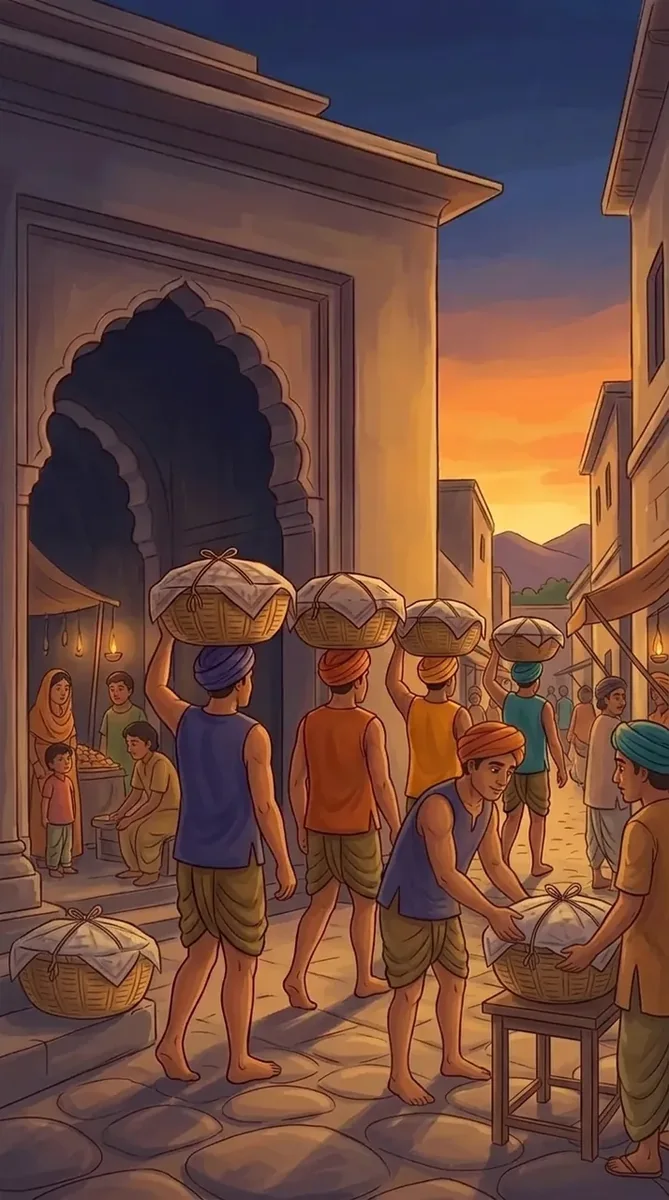
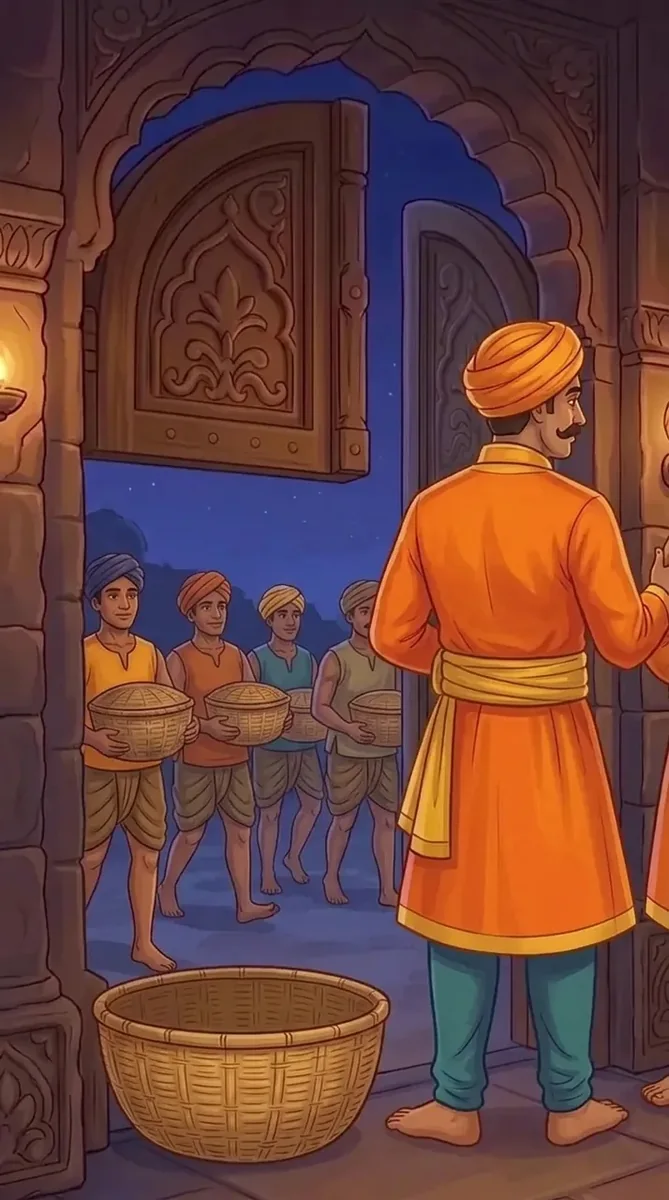
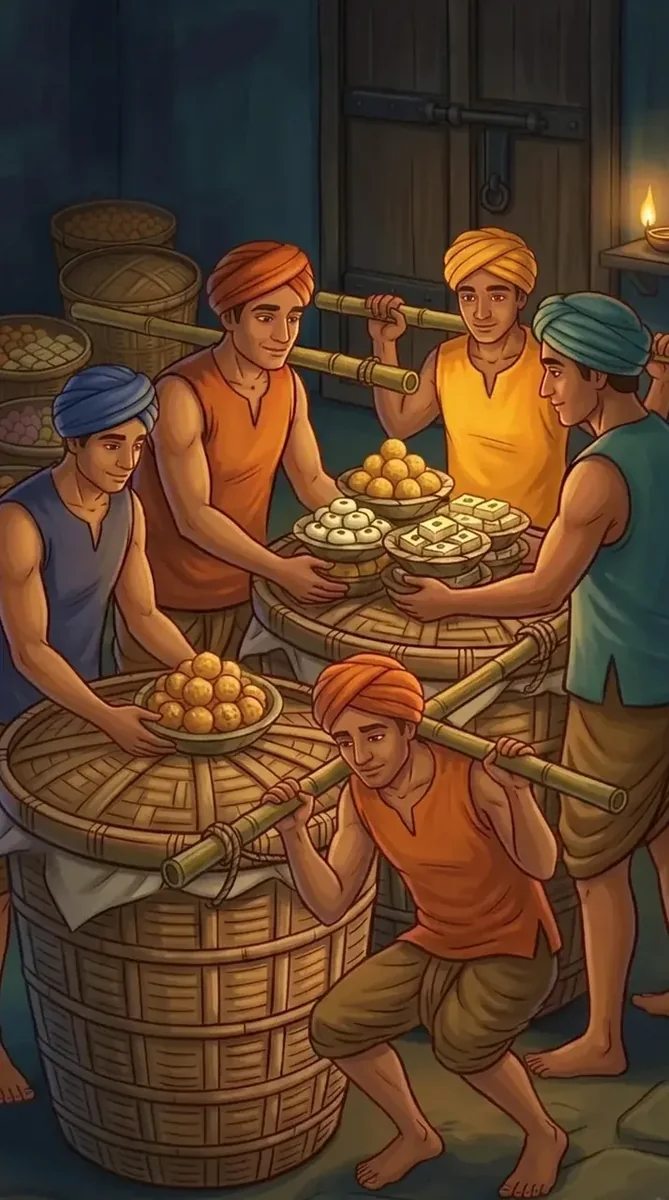



What he does not do, Naani points out, is shout or get angry. He sits and thinks, like a chess player planning the next move. One day there is a sparkle in his eyes. He announces that he wishes to pray, and will send mithai daily to the temples and the poor. Enormous bamboo baskets are brought — so big a grown man could sit inside — and filled with laddoos, pedas and barfi. From that evening, sweets leave the haveli every day. The guards are chaukanne, very alert: they stop each basket and lift the lid. Nothing but sweets. Naani pauses and asks your child: will the guards keep opening every basket, every day, haan ya na?
Naani saysवे चुपचाप बैठकर सोचते रहे — जैसे शतरंज खेलने वाला अपनी अगली चाल सोचता है।He sat quietly and thought — the way a chess player thinks out the next move.
One day, two days, ten days… the same baskets, the same laddoos. Slowly the guards get bored. They lift the lid a crack and wave: jao, jao, it is only sweets. And then comes an evening when they let every basket through unopened. Shivaji watches from the window and smiles a little — but hurrying spoils a job that is nearly done, so he waits for the right night.
Naani saysपर वे जानते थे — जल्दी करने से बना काम बिगड़ जाता है।But he knew — hurrying spoils a job that is nearly done.
When it comes, the crickets are singing and the haveli's lamps go out one by one. Shivaji lifts Sambhaji into his lap: not a sound, beta; close your eyes and think that we are going home. The boy climbs into the biggest basket, his father into another, sweets go on top, and the carriers lift them. At the gate everyone's breath stops… the guard waves… and the baskets pass. Far outside the city the lids open to cold night air and stars. Dressed as sadhus so no one will know them, they walk for days until one morning the familiar hills appear, the fort gates open, and Jijabai comes running. Shivaji is in his mother's arms, Sambhaji in his grandmother's lap, and that night the whole fort sleeps well, because everyone is home.
The value this story teaches
Patience is the value four-to-seven-year-olds find hardest, because everything in them says now. Waiting a turn, waiting for a cake to bake, waiting ten days for anything at all. Yet patience is what turns a clever idea into a finished one, and a child who sees it working — rather than being told about it — begins to trust it.
Shivaji's whole plan is waiting. He sends out sweets for ten days while the guards get bored, and when he could probably slip out earlier he waits anyway, because jaldi karne se bana kaam bigad jaata hai — hurrying spoils a job that is nearly done. Naani asks your child mid-story whether the guards will keep checking, so they feel the waiting themselves. The seekh — not every lock opens by force; sometimes patience and good sense are the key — arrives only after the proof.
How to talk about it at bedtime
- Ask your child: why did Shivaji wait so many days instead of hiding in the very first basket?
- Try: pick one thing tomorrow that needs waiting — a seed, a cake, a turn — and call it your child's "sweet basket".
- Ask: when something will not open, what could you try before pushing harder? Naani asks how your child calms down and finds a way.
When to pick this story
- When your child is in a pushing-and-shouting phase with anything that will not work
- The night before a long wait — a journey, a result, a festival still days away
- Around Shivaji Jayanti, or whenever Maharashtra's hero comes up at school
Try asking your child
After the story, or the next morning on the way to school:
- Why did Shivaji Maharaj send out baskets of sweets every single day before he hid in one himself?
- What did Shivaji tell little Sambhaji to think about inside the basket? Would you have managed to stay quiet?
- Next time something will not open or will not work, what could you try instead of pushing harder?
Meet the characters
The brave, wise king held in Agra, who thinks like a chess player
His small son, who must stay perfectly quiet inside the biggest basket
Shivaji's mother, who runs to the fort gates when he comes home
Alert at first, they check every basket — until the laddoos bore them
From the app-store reviews
Two of the public reviews parents have left on Google Play and the App Store, quoted exactly as they wrote them.
“an intellectual way to describe the old stories for kids .”
Nice“Really cute idea for bedtime! I love how Naani actually listens when kids interrupt and responds as part of the story. The mix of Hindi and English feels really natural, and the gentle lessons are a nice touch. Such a lovely way to wind down before sleep!”
Give your child a story with a value every night
Naani tells Shivaji Maharaj ki Chaturai in warm Hindi, shows the pictures, asks a question halfway and listens to your child's answer. One story, one seekh, then good night.
Listen tonight — free- Free stories every night
- No ads
- Your child’s voice erased after 24 hours
- Made in India
About this story
- Language: Hindi — simple, in a grandmother’s voice
- Ages: 4–7
- Listen time: about 11 minutes
- Value: Patience, Wisdom & thinking, Courage
- World: Tales of Valour
- Theme: Bravery also includes intelligence, patience and preparation.
Also plays in the browser: app.naani.live/stream/shivaji-maharaj-s-escape-from-agra (sign-in required).
Parents also ask
Which Shivaji Maharaj story is this?
It is the famous escape from Agra. Shivaji and his son Sambhaji are held in a haveli by the emperor's guards. Shivaji sends out big baskets of sweets every day until the guards stop checking them, then hides himself and his son in two baskets and is carried out. Dressed as sadhus, they walk home to Jijabai.
Can a 4-year-old follow the Shivaji escape story?
Yes. No one is hurt and no one fights. The emperor is mentioned once and never appears; the only danger is a guard lifting a lid. Most of the nine minutes are about waiting, laddoos and a quiet night-time plan, and the story ends with a long hug from Maa Jijabai.
Who was Shivaji Maharaj?
Shivaji Maharaj was a king from the mountains of western India, remembered as the founder of the Maratha kingdom and for his courage, clever strategy and love for his mother Jijabai. Naani's story keeps to what a small child can hold: a wise king far from home, patient enough to out-think the guards who were watching him.
Next story

Jhansi ki Rani Lakshmibai
A Rani Lakshmibai story that shows a five-year-old you can be scared in the dark and still do the brave thing.
More Tales of Valour
All Tales of Valour → Wisdom
Hanuman aur Sanjeevani Booti
A Hanuman story that shows a five-year-old that when a job makes no sense, you stop, think, and find another way.
 Friendship
Maharana Pratap aur Chetak
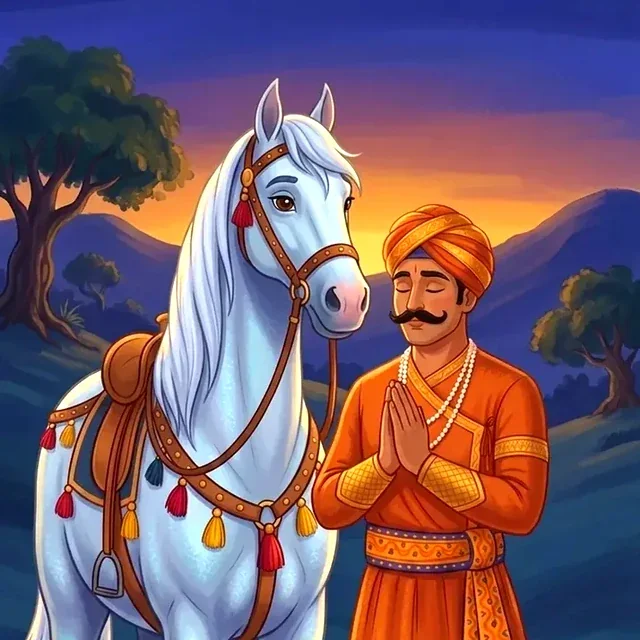
A Maharana Pratap story that shows a six-year-old what a loyal friend does — and how to be one back.
 Courage
Veer Bhagat Singh
A Bhagat Singh story that shows a four-year-old that courage is planting the stick again, deeper, after it falls.
More stories that teach patience
Waiting, trying again, and letting slow things be slow.
 Patience
Sone ka Hans
A Jataka story that teaches patience and gratitude without a lecture — one golden feather at a time.
 Patience
Dheere Chalne wala Waqt
A calming bedtime story that shows a hurrying child why slowing down gets you there sooner.