The Golden Swan — Sone ke Hans ki kahani, told for kids in Hindi
A Jataka story that teaches patience and gratitude without a lecture — one golden feather at a time.
सुनहरे पंखों वाला हंस — एक बार में बस एक पंख

Hear Naani tell it
The story
If your child finds waiting unbearable, this is a story that makes patience feel worth it. Muniya has almost no rice, and still she sets a few grains aside each day for the courtyard birds. She lives in a small village house with her brother Gopu and their Amma; between them they own a little rice and one thin razai. Jiske paas thoda hai, Amma says with a laugh, woh bhi baant sakta hai — whoever has a little can still share.
Naani saysअम्मा हँसकर कहतीं, जिसके पास थोड़ा है, वह भी बाँट सकता है।Amma would say with a laugh: whoever has a little can still share.
One evening, as the crickets begin, something glimmers at the window. A huge swan is sitting on the sill, its feathers the colour of the setting sun. It speaks. I have watched you, it says; you have little and still you feed the birds, so I have brought you something. It lowers its long neck and lets one golden feather fall into Amma's palm. One at a time, it says — I will come again. Naani pauses here and asks your child how it would feel if a golden feather landed in their own hand: khushi, ya hairaani?
Naani saysएक बार में बस एक, उसने कहा, मैं फिर आऊँगा।Just one at a time, it said — I will come again.
The story in pictures
Frames from Naani’s telling, in story order — the pictures your child sees while she speaks.
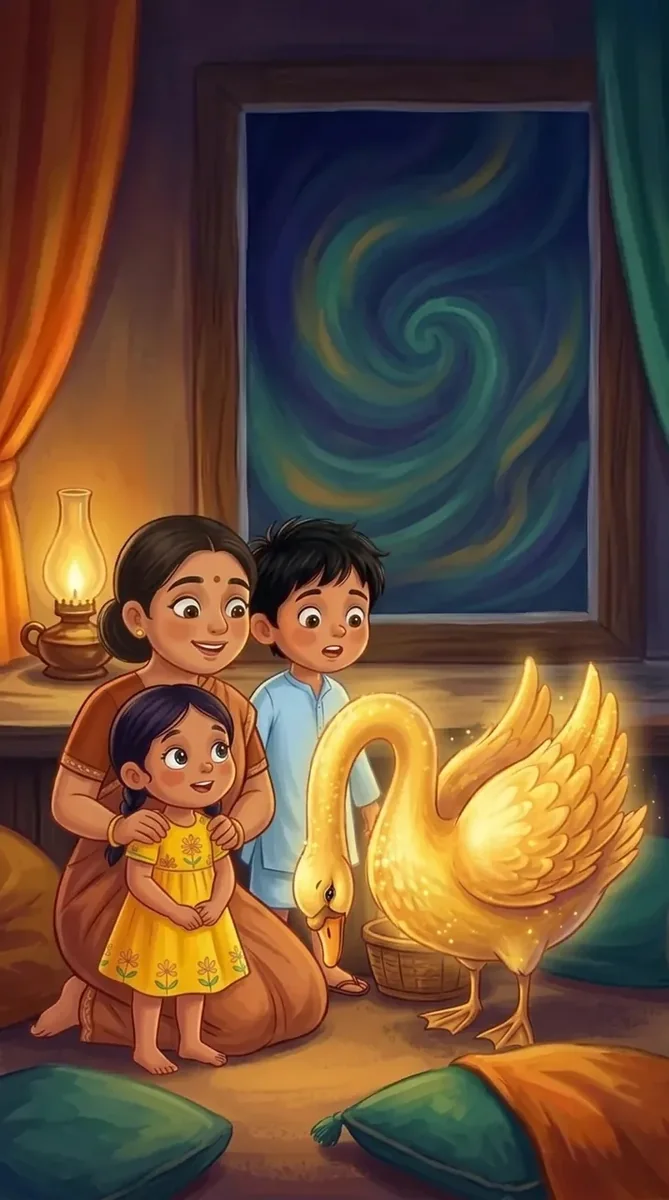


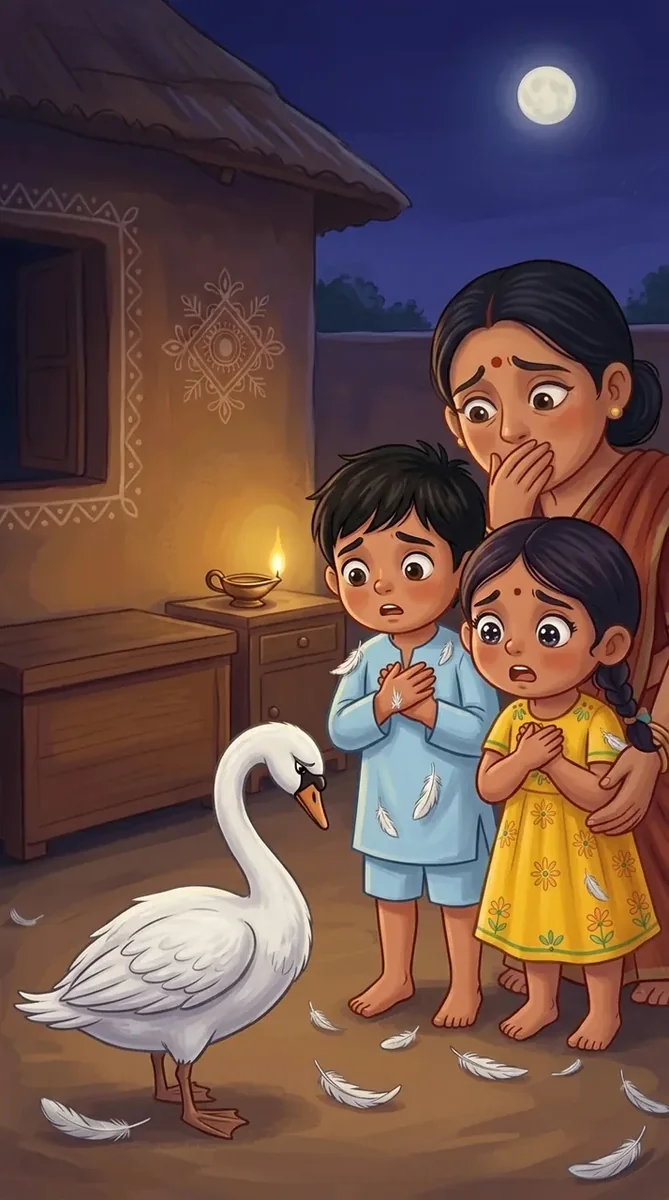


The feather buys rice and a thick new quilt. The swan keeps its word, comes every few days, always leaves exactly one feather, and life grows gently better. Then the monsoon arrives, the roof starts to leak, and fear creeps in with the damp. What if the swan stops coming? Fear suggests a hasty plan: next time, take all the feathers at once and keep them safe. The next evening they do exactly that, without letting the swan speak — and when they open their hands, every feather has turned plain white.
Naani saysपर जैसे ही उन्होंने अपनी हथेलियाँ खोलीं… सारे पंख सादे सफ़ेद हो चुके थे!But the moment they opened their palms… every feather had turned plain white!
The swan is not angry. My feathers stay golden only when they are given with love, one by one, it says softly; snatched in a hurry, they turn ordinary. And it flies away across the river. The house goes quiet. Muniya cries, Amma gathers both children in, and then Gopu says the sentence that changes everything: we will wait for the swan every evening, and ask for nothing.
Naani saysमेरे पंख प्यार से मिलें, एक-एक करके, तभी सुनहरे रहते हैं।My feathers stay golden only when they are received with love, one by one.
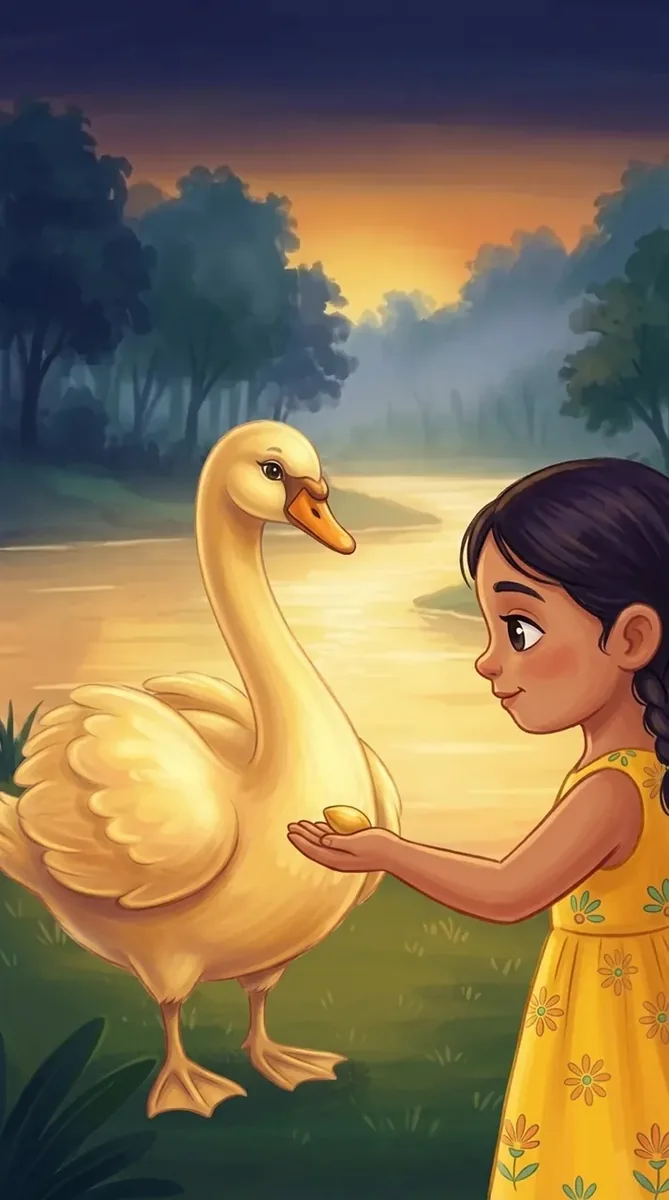
So every evening the three walk the mud path to the river, leave a few grains, look up and say sorry, and thank you for everything. The rains pass. And one bright morning something flashes above the far bank — the swan, flying back. I heard you every evening from the other side, it tells them. You stopped asking and learned to give again. It lays one golden feather on Muniya's palm. That night stomachs and hearts are full, and the best thing, Naani says, is no longer the feather. It is the swan coming.
The value this story teaches
Waiting is physically hard for a five-year-old; the wanting is immediate and the future is abstract. What they can grasp is a picture — and this story's picture is a golden feather that turns plain white the moment it is grabbed in a hurry. Nobody has to explain it.
The swan gives one feather at a time and the family's life gets gently better. It is fear, not wickedness, that makes them snatch, and the consequence is quiet: the feathers go dull and the swan flies away. The repair is just as quiet — grains left by the river every evening, a thank-you spoken to the sky, and a swan that has been listening from the far bank. Your child learns that good things come slowly and stay when you are grateful for them.
How to talk about it at bedtime
- Ask your child: why did the feathers turn white? What were Gopu, Muniya and Amma feeling when they grabbed them?
- Try: name one good thing from today together and say thank you for it, the way the family did by the river.
- Ask: what is something you are waiting for right now, and what could you do while you wait?
When to pick this story
- When your child wants everything at once — all the sweets, all the presents, now
- The week before a birthday or Diwali, when the waiting is hardest
- After a greedy moment your child already feels a little bad about
Try asking your child
After the story, or the next morning on the way to school:
- Why did the swan give only one feather at a time? What happened when the family took them all at once?
- What did Gopu, Muniya and Amma do every evening after the swan left? Why do you think it came back?
- When you really want something — the whole packet of biscuits, all the presents now — what helps you wait?
Meet the characters
A talking swan with feathers like the evening sun, who rewards quiet generosity one feather at a time.
The daughter who saves grains from her own small share for the courtyard birds.
The son whose fear starts the hasty plan — and whose idea of waiting without asking brings the swan back.
Their mother, who owns almost nothing and teaches that whoever has a little can still share.
From the app-store reviews
Two of the public reviews parents have left on Google Play and the App Store, quoted exactly as they wrote them.
“Great stories and really interactive. My kid love it”
“an intellectual way to describe the old stories for kids .”
Give your child a story with a value every night
Naani tells Sone ka Hans in warm Hindi, shows the pictures, asks a question halfway and listens to your child's answer. One story, one seekh, then good night.
Listen tonight — free- Free stories every night
- No ads
- Your child’s voice erased after 24 hours
- Made in India
About this story
- Language: Hindi — simple, in a grandmother’s voice
- Ages: 4–7
- Listen time: about 13 minutes
- Value: Patience, Gratitude, Sharing
- World: Panchatantra & Jataka
- Theme: Gratitude and patience preserve blessings; greed destroys them.
Also plays in the browser: app.naani.live/stream/the-golden-swan (sign-in required).
Parents also ask
What is the story of the Golden Swan?
A poor family that shares its little rice with birds is visited by a swan with golden feathers, who gives them one feather at a time. Fear makes them pluck all the feathers at once; the feathers turn white and the swan leaves. When they learn to wait and give again, it returns. It is the Suvannahamsa Jataka.
Is the Golden Swan a Panchatantra or a Jataka story?
It is a Jataka tale — one of the Buddhist stories of the Buddha's earlier lives, in which the golden swan is the Bodhisatta. Naani shelves it with the Panchatantra under 'Panchatantra & Jataka' because the two collections share the same animal-fable world and many of the same morals.
Does the family get punished for taking the feathers?
Gently. The swan simply explains and leaves; nobody is scolded, and the three put things right themselves by going to the river each evening to say sorry and thank you. Children remember the swan's return far more than the loss, which is why it settles rather than upsets at bedtime.
Next story
Chand par Khargosh
A Jataka story that teaches your child that giving is about the heart, not the size of the gift.
More Panchatantra & Jataka
All Panchatantra & Jataka → Courage
Chintu aur Magarmachh
A Panchatantra story that shows your child what to do with fear: breathe once, then think.
 Honesty
Neela Siyaar
A Panchatantra story that makes telling the truth feel like relief, not punishment.
 Wisdom
Sher aur Chalaak Khargosh
A Panchatantra story that shows your child how a calm, thinking mind beats a loud, strong one.
More stories that teach patience
Waiting, trying again, and letting slow things be slow.
 Patience
Shivaji Maharaj ki Chaturai
A Shivaji Maharaj story that shows a six-year-old that courage is mostly patience and thinking.
 Patience
Dheere Chalne wala Waqt
A calming bedtime story that shows a hurrying child why slowing down gets you there sooner.