Makhan Chor — the story of little Krishna and the butter pot, in Hindi
A Krishna story that teaches a four-year-old to ask openly instead of sneaking — honesty, without a lecture.
माखन चोर — नन्हे कन्हैया और माखन की मटकी की कहानी

Hear Naani tell it
Watch a glimpse
The story
If your child has ever stood in front of you with chocolate on their chin saying "maine nahi khaya", this is the story to tell them tonight. Makhan Chor is the gentlest honesty story in the Indian canon: a little boy who sneaks, a mother who sees straight through him, and an ending where the truth is met with love instead of a scolding. Children come away knowing that asking is easier than hiding — and parents come away with a line they can reuse for years: "Bhookh lagi thi, toh maang lete."
It opens on an early morning in Gokul. Birds are chattering and from Yashoda Maiya's courtyard comes the steady sound of dahi being churned into fresh makhan — white, soft butter that melts the moment it touches the tongue. In that house lives a small boy with round cheeks and mischievous eyes who loves makhan more than anything in the world. Maiya has worked out who has been emptying her pots, so she now hangs the matki from the ceiling beam, far above little Krishna's reach. When she goes to the ghat for water and the house falls quiet, he tiptoes in. His ankle bells tinkle; he freezes. He jumps, stands on his toes — still too high. Then three friends appear at the door, and Krishna has a plan.
Naani saysऔर उस घर में एक नन्हा सा बच्चा था, जिसे माखन दुनिया में सबसे ज़्यादा पसंद था — कृष्ण।And in that house lived a tiny boy who loved butter more than anything in the world — Krishna.
Naani saysकृष्ण दबे पाँव आँगन में आए — और उनके पैरों के घुँघरू हौले से बज उठे।Krishna crept into the courtyard on tiptoe — and the little bells on his ankles softly rang.
The story in pictures
Frames from Naani’s telling, in story order — the pictures your child sees while she speaks.


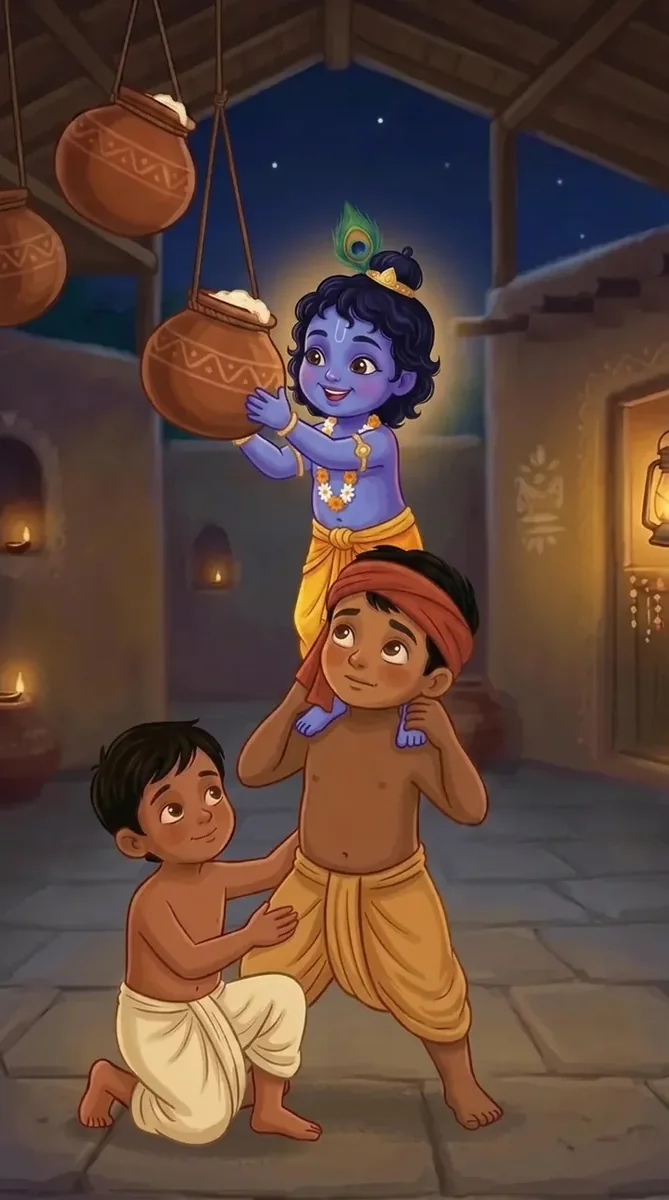



What follows is the moment every child waits for: Mansukh, Madhu and Chhotu build a wobbly human ladder, the strongest at the bottom and the smallest on top, everyone holding their breath as it tilts. Naani tells this part slowly, and here she stops to ask your child a question — will the ladder hold? — and waits for the answer before going on.
Naani saysचढ़े नन्हे कृष्ण। सीढ़ी ज़रा सी हिली। अरे अरे!Up climbed little Krishna. The ladder wobbled, just a little. Arre, arre!
Of course there is a feast, and Krishna shares it with every friend before taking the biggest scoop himself: butter on cheeks, butter on fingers, butter on the tip of a nose. And of course Maiya comes home early. The friends scatter over the wall, and only Krishna is left in the middle of the courtyard, covered in makhan, saying with very round eyes that he did not eat any.
Naani saysकृष्ण ने बड़ी-बड़ी आँखें और गोल कीं और बोले, नहीं मैया! मैंने नहीं खाया!Krishna made his big eyes even rounder and said: No, Maiya! I didn't eat it!
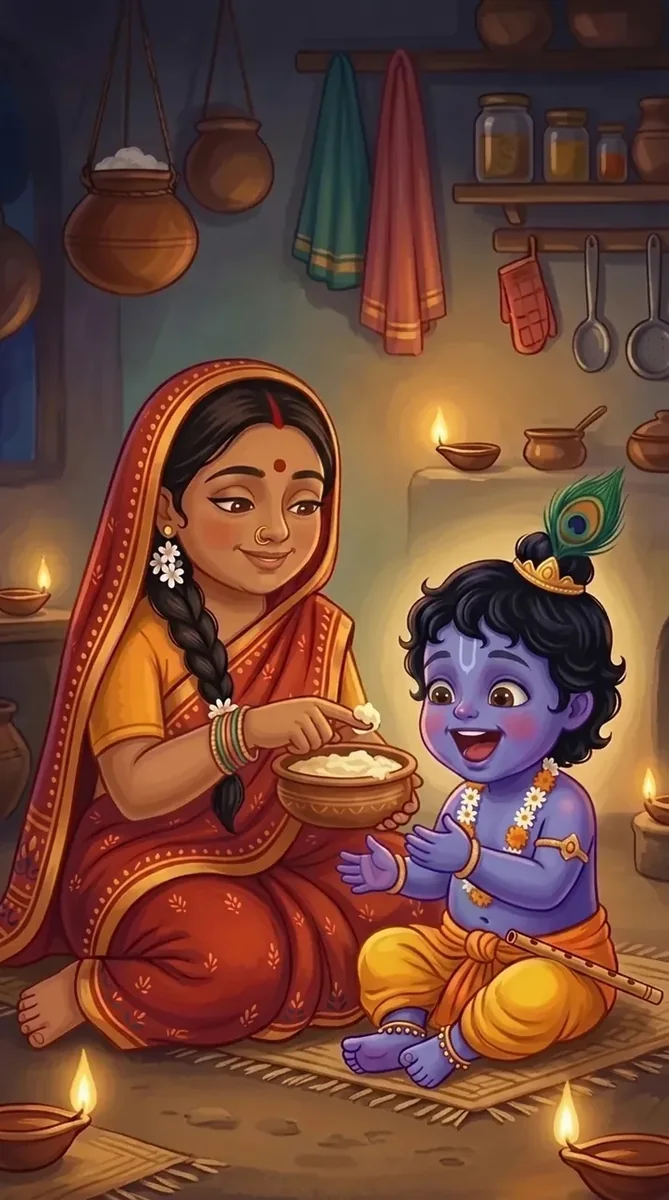
The ending is why this story has survived a thousand years of bedtimes. Yashoda looks at that butter-smeared face and her anger melts — exactly like butter. She lifts him into her lap, wipes his cheek and says: if you were hungry, you only had to ask; I would have fed you myself. Then she does exactly that, a little at a time. Evening settles over Gokul, the stars come out, and the little makhan chor falls asleep on his mother's shoulder with one small smudge of butter still on his cheek.
The value this story teaches
Between four and seven, children discover that a small untruth can get them out of a tight spot — and they test it. Punishing the fib usually teaches them to fib better. What works is showing them, again and again, that the truth is safe and that asking gets them further than hiding. A story does this far more effectively than a talk, because the child is on Krishna's side the whole way and feels the relief of being forgiven as if it were their own.
That is the moment this story is built around: butter on his nose, "maine nahi khaya", and a mother who does not shout. Yashoda names what she sees, laughs, and offers the better path — ask me, I will feed you myself. Your child hears honesty rewarded with a lap, a bowl of fresh makhan and a good night's sleep. Over a few retellings, "Kanha ki tarah maang lo" becomes a family shorthand.
How to talk about it at bedtime
- Ask your child: when Maiya asked "maakhan tumne khaya?", what did Krishna say — and what was on his nose while he said it?
- Try: "Agar tumhe kuch bahut chahiye ho, mujhse kaise maangoge?" Let them practise the sentence out loud, and promise you will listen like Maiya did.
- Notice together: Maiya was not angry for long. Ask what made her laugh, and whether a true answer would have made it even easier.
When to pick this story
- When your child has told a small fib and you want to talk about it without a lecture
- A night when they are missing their grandmother — this is the story every Naani told
- After a sibling has been caught sneaking a sweet, so both can hear how asking works better
Try asking your child
After the story, or the next morning on the way to school:
- Why did Yashoda Maiya hang the matki so high? What would you have done if you were Krishna?
- Krishna said "maine nahi khaya" with butter on his nose. Was that a good idea? What could he have said instead?
- If you really wanted something — a sweet, a toy, a hug — who would you ask, and how?
Meet the characters
A small boy in Gokul with round cheeks and a plan, who loves fresh butter more than anything.
His mother — strict enough to hang the pot from the ceiling, soft enough to feed him herself.
The three friends who become a wobbly human ladder; Mansukh is the strongest and stands at the bottom.
From the app-store reviews
Two of the public reviews parents have left on Google Play and the App Store, quoted exactly as they wrote them.
“an intellectual way to describe the old stories for kids .”
Nice“Really cute idea for bedtime! I love how Naani actually listens when kids interrupt and responds as part of the story. The mix of Hindi and English feels really natural, and the gentle lessons are a nice touch. Such a lovely way to wind down before sleep!”
Give your child a story with a value every night
Naani tells Makhan Chor in warm Hindi, shows the pictures, asks a question halfway and listens to your child's answer. One story, one seekh, then good night.
Listen tonight — free- Free stories every night
- No ads
- Your child’s voice erased after 24 hours
- Made in India
About this story
- Language: Hindi — simple, in a grandmother’s voice
- Ages: 4–7
- Listen time: about 6 minutes
- Value: Honesty, Sharing, Kindness & empathy
- World: Stories of Krishna
- Theme: Innocent mischief
Also plays in the browser: app.naani.live/stream/makhan-chor (sign-in required).
Parents also ask
Is the Makhan Chor story suitable for a 4-year-old?
Yes. It is one of the gentlest Krishna stories: no villain, no fear, and an ending where a mother laughs and feeds her child. Naani's version runs about six minutes in simple Hindi, with short questions in the middle that a four-year-old can answer.
What is the moral of the Makhan Chor story?
That with the people who love you, asking works better than sneaking — and that a true answer is always safe. Yashoda does not punish Krishna; she feeds him herself, which is why children remember the lesson as warmth rather than as a rule.
Why is Krishna called Makhan Chor?
As a child in Gokul, Krishna was famous for stealing freshly churned butter (makhan) from his mother Yashoda and the other gopis — so lovingly that the nickname Makhan Chor became a term of endearment rather than a complaint.
Next story

Krishna aur Kaliya Naag
A Krishna story about using strength to protect others, and forgiving the one who did wrong.
More Stories of Krishna
All Stories of Krishna →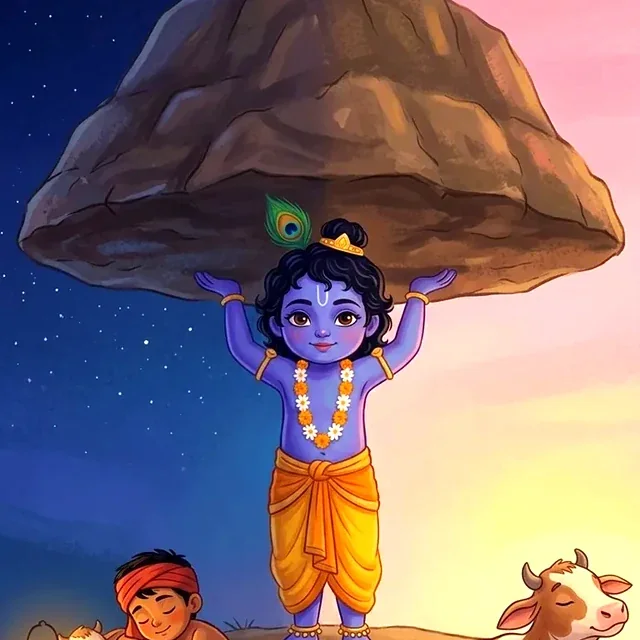 Courage
Govardhan Parvat aur Krishna
A Krishna story about a small boy using his strength for everyone — and a village that stands together.
 Faith
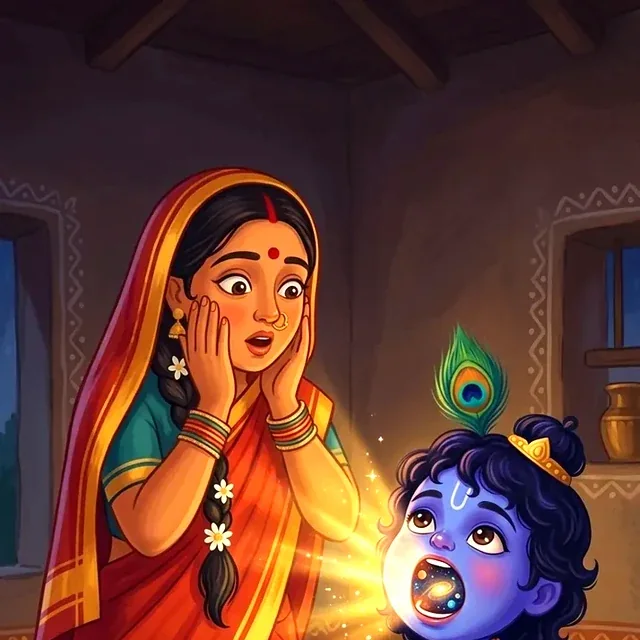
Kanha ke Munh mein Duniya
A Krishna story that teaches your child to look closely at the people they love — there is a whole world inside.
 Friendship
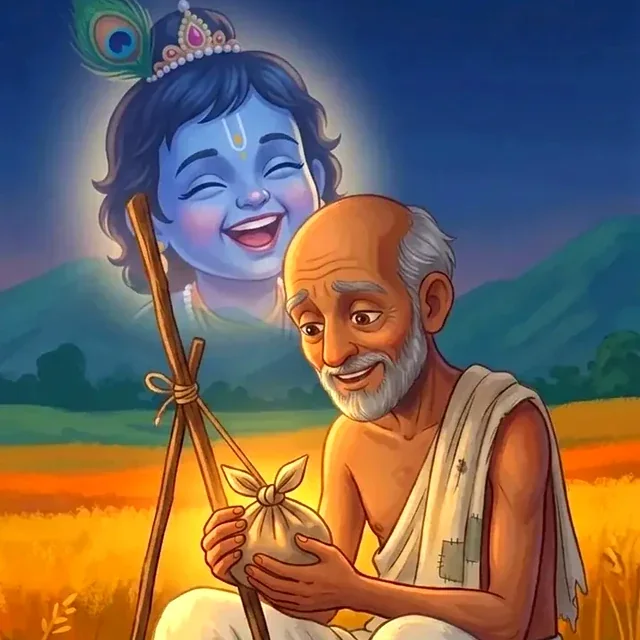
Krishna aur Sudama
A Krishna story that teaches true friendship looks at the heart, not at what someone owns.
More stories that teach honesty
Telling the truth even when a small lie would be easier.
 Honesty
Neela Siyaar
A Panchatantra story that makes telling the truth feel like relief, not punishment.
 Honesty
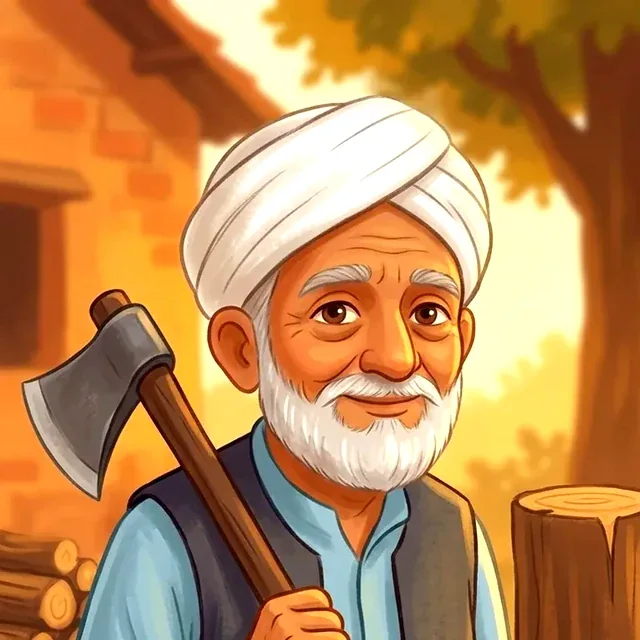
Imaandaar Lakarhara
A moral story that teaches honesty without a lecture — a poor man says no to gold because it is not his.
 Honesty
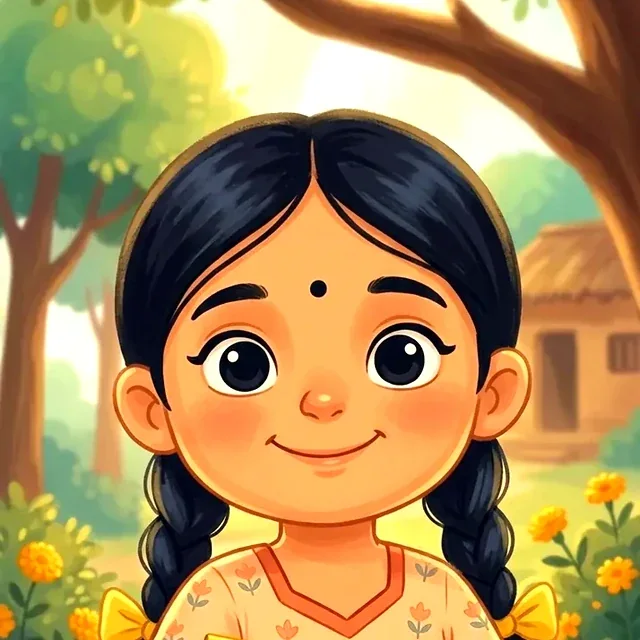
Naani ki Teen Chhalniyan
A moral story about honesty and kind words — three simple questions your child can ask before repeating anything.