Chanda Mama ki Chamak — the moon that forgot to shine, a gentle bedtime story in Hindi
A gentle bedtime story for the child who feels overlooked — about a shine that stays even when no one says thank you.
वह चाँद जो चमकना भूल गया — मुनिया और चाँदनी की कहानी

Hear Naani tell it
Watch a glimpse
The story
This is the quietest story on Naani's shelf, and the one to pick when your child feels overlooked: it is about a shine that stays even when nobody says thank you. Far away, below a hill, there is a small village, and above it lives our moon — round, pale and very dear. Every night he lays his cool chandni over rooftops, courtyards and fields. But lately big clouds have been covering him, and here is the strange thing: not one person has looked up and asked where the moon has gone. Not one. So the moon begins to think: perhaps nobody needs my light. Whether I shine or not — who cares?
Naani saysगाँव में किसी ने ऊपर देखकर पूछा ही नहीं — अरे, चाँद कहाँ गया? कोई नहीं। एक भी नहीं। चाँद सोचने लगा…Nobody in the village looked up and asked — hey, where did the moon go? Nobody. Not one. The moon began to think…
Then one evening the clouds clear. Only a single fat cloud is left in a corner of the sky — and the moon slides across and hides behind it, on purpose. The village goes ghup andhera, so dark you cannot see your own hand. An old amma cannot find her needle. By the cowshed a cow lows for her calf, who cannot find his way home. And at a window a little girl called Muniya looks up at the black sky and whispers: Chaand, where are you?
Naani saysउस रात… चाँद खुद उस बादल के पीछे जाकर छुप गया!That night… the moon went and hid behind that cloud himself!
The story in pictures
Frames from Naani’s telling, in story order — the pictures your child sees while she speaks.
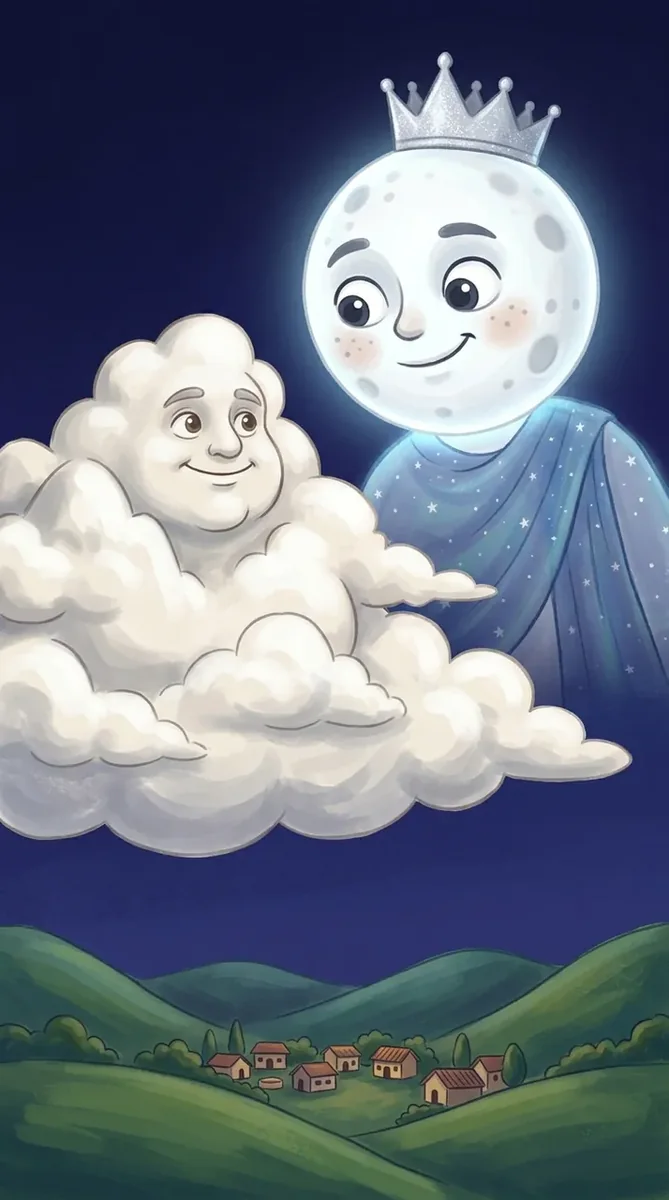
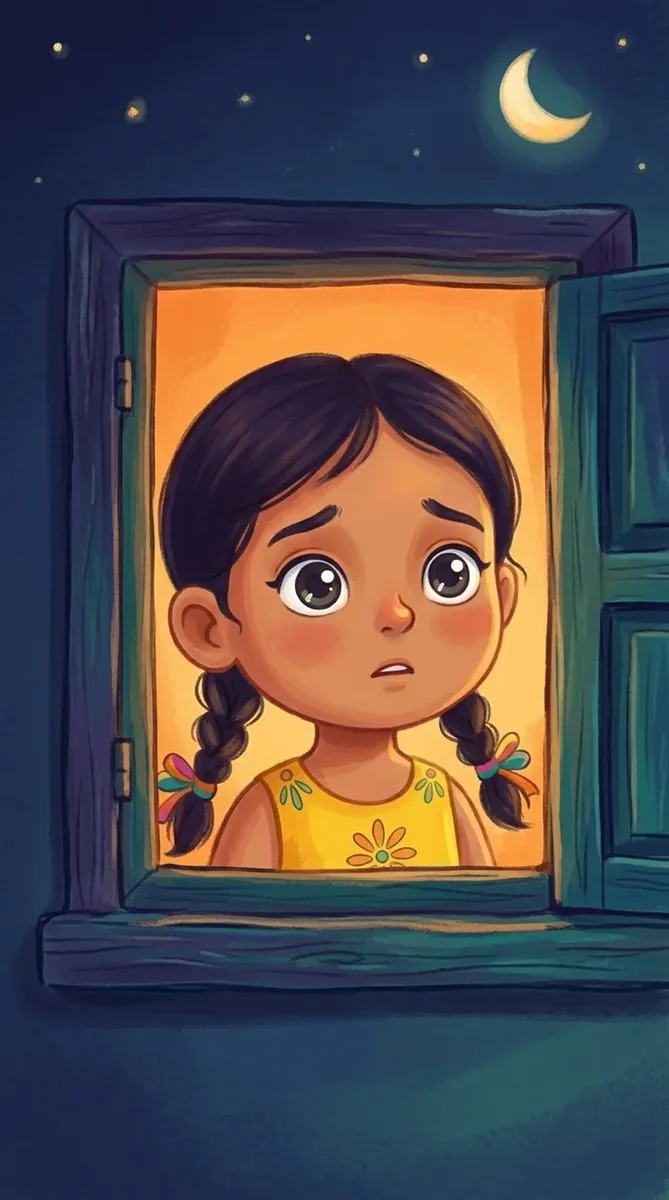

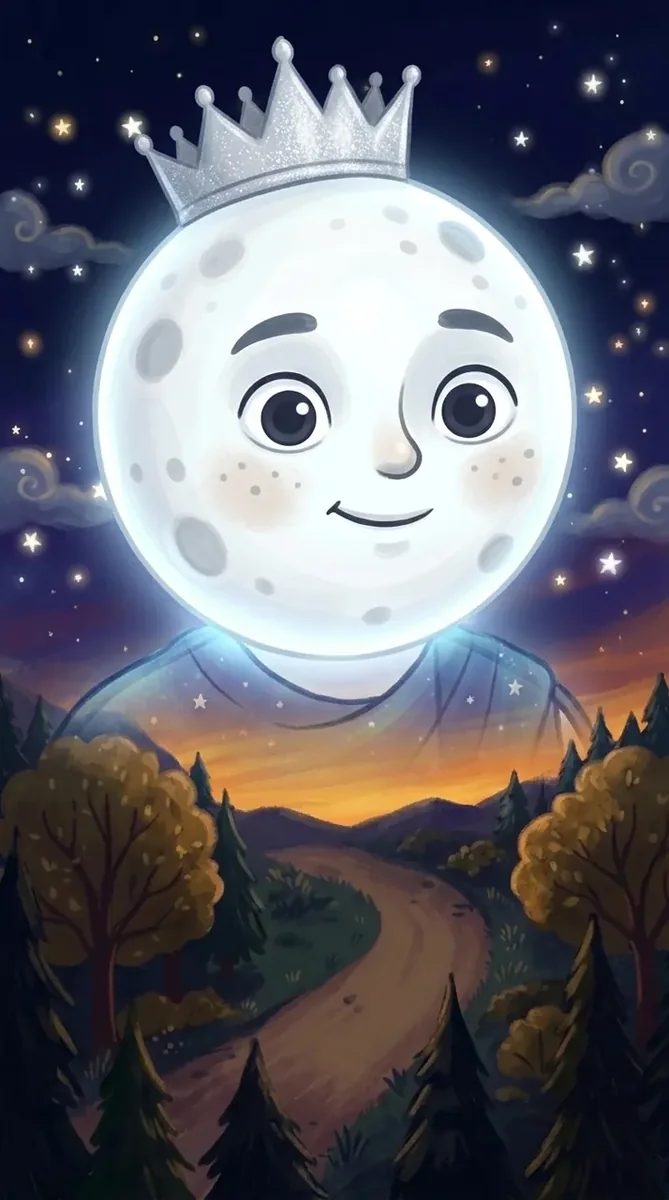

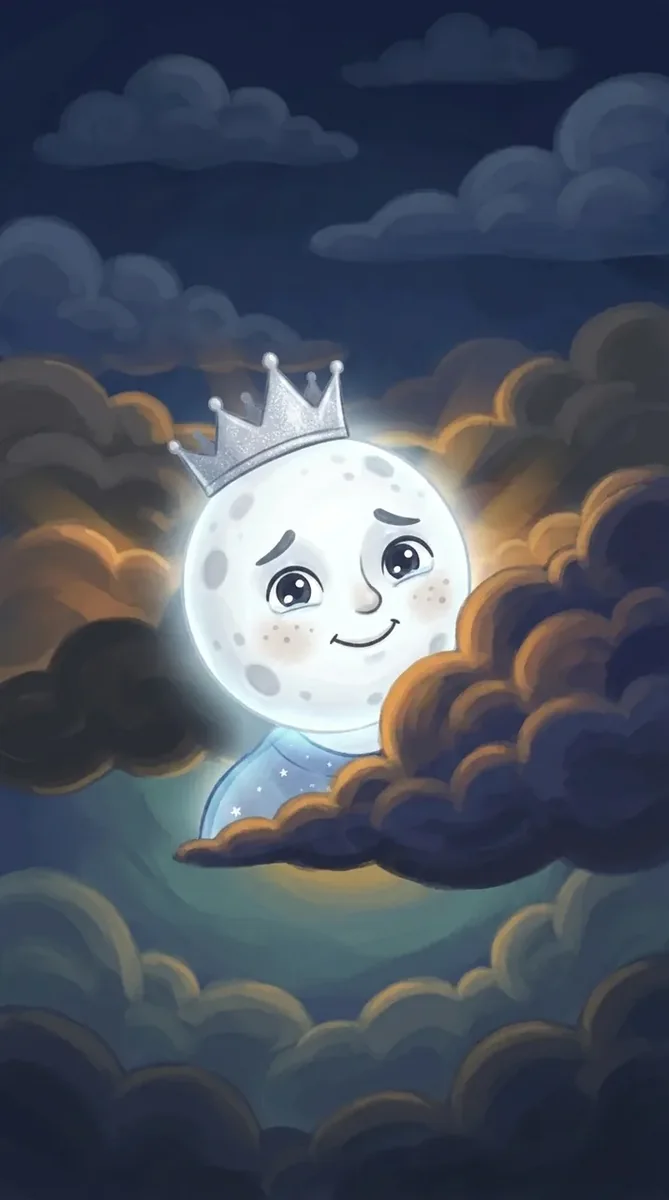
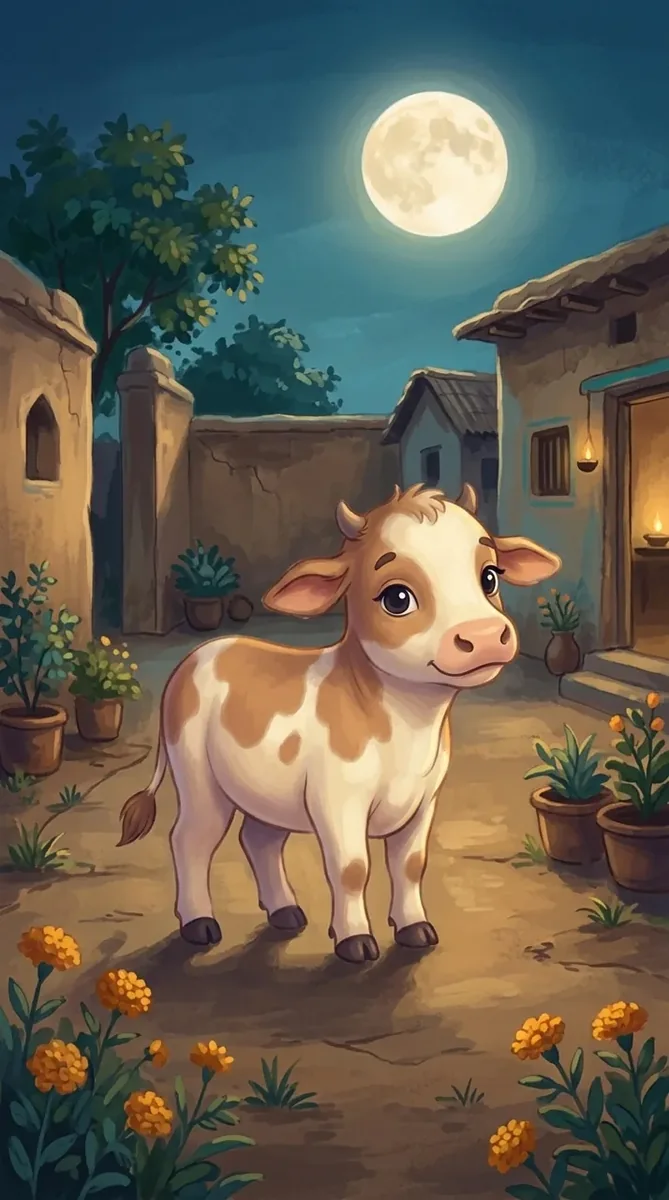
Naani pauses here and asks your child how the moon must be feeling behind his cloud — happy or sad? — then goes on. The next night is the same: no moonlight. Muniya runs to her friends. I think the moon is sad, she says. We never once said thank you to him. But he is so high up — what can they do? Muniya's eyes light up. Come on. We'll go and talk to him ourselves.
Naani saysचाँद कितनी रातों से नहीं आया। मुझे लगता है… वह उदास है। हमने उसे कभी 'शुक्रिया' जो नहीं कहा।The moon hasn't come for so many nights. I think… he is sad. We never once said thank you to him.
With one small lantern the children climb the hill closest to the sky, while the moon peeps down from behind his cloud, puzzled. At the top, Muniya cups her hands round her mouth: Chaand! O Chaand! We know you're there. The children call out: in your chandni Amma finds her needle. In your chandni the calf finds his way home. We don't say it every day, Muniya adds softly — but we love your light. Truly.
Naani saysतुम्हारी चाँदनी में अम्मा को उनकी सुई मिल जाती है! तुम्हारी चाँदनी में बछड़े को घर का रास्ता दिखता है!In your moonlight Amma finds her needle! In your moonlight the calf sees the way home!
Behind the cloud, the moon's heart goes warm, as if someone has hugged him. A breeze stirs, the cloud slides, the moon gathers his courage — and comes out. The whole village bathes in milk-white light. The calf runs to his mother; the needle is found; the river turns to silver. Later, moonlight falls across Muniya's pillow like a whispered thank you, and the moon decides: let the clouds come. I'll keep shining, whether anyone says so or not.
The value this story teaches
Children of this age live on noticing. When praise stops — a new baby, a busy week, a teacher's attention elsewhere — many quietly conclude that they do not matter. Emotional resilience here is the understanding that their worth does not switch off when the attention does.
The moon hides on purpose because nobody asked where he had gone. Muniya's climb up the hill, and the children calling out what his light does — Amma's needle, the calf's way home — bring him out. But the story's last turn is his own: let the clouds come, I'll keep shining, whether anyone says so or not.
How to talk about it at bedtime
- Ask your child: why did the moon hide? Had anyone been unkind to him?
- Try: before sleep, name one thing your child did today that nobody noticed — and notice it.
- Ask your child: whose light do we forget to thank at home? Shall we tell them tomorrow?
When to pick this story
- After a day when your child felt ignored or outshone
- When a new sibling is taking all the attention
- A very quiet, dark night when a slow story is needed
Try asking your child
After the story, or the next morning on the way to school:
- Why did the moon hide behind the cloud on purpose? Had anyone been unkind to him?
- Who could not find things in the dark, and how did the moonlight help each of them?
- The moon shines whether people say thank you or not. Is there something you do well even when nobody notices? Who could you thank tonight?
Meet the characters
The round, pale moon who stops shining because nobody seems to need his light
A little girl who notices the moon is missing and leads her friends up the hill
The villagers who need the moonlight — one for her needle, one to find his way home
From the app-store reviews
Two of the public reviews parents have left on Google Play and the App Store, quoted exactly as they wrote them.
“Great stories and really interactive. My kid love it”
“an intellectual way to describe the old stories for kids .”
Give your child a story with a value every night
Naani tells Chanda Mama ki Chamak in warm Hindi, shows the pictures, asks a question halfway and listens to your child's answer. One story, one seekh, then good night.
Listen tonight — free- Free stories every night
- No ads
- Your child’s voice erased after 24 hours
- Made in India
About this story
- Language: Hindi — simple, in a grandmother’s voice
- Ages: 4–7
- Listen time: about 11 minutes
- Value: Emotional resilience, Self-belief, Gratitude
- World: World of Dreams
- Theme: Your value does not disappear when nobody notices or praises you.
Also plays in the browser: app.naani.live/stream/the-moon-that-forgot-to-shine (sign-in required).
Parents also ask
Is this a good story for falling asleep?
It is one of Naani's quietest. Most of it happens at night, under stars and then moonlight; nothing frightening occurs beyond a dark evening, and the story closes with moonlight on Muniya's pillow. Naani ends by asking your child to picture the moon behind a cloud, still there.
What is the moral of Chanda Mama ki Chamak?
That your worth does not vanish when nobody notices or praises you. The moon hides because he feels unneeded; the children's thank-you brings him out, but he decides to keep shining whether or not anyone says so. The seekh Naani gives: your shine stays inside you — no one can take it.
Who is Chanda Mama?
Chanda Mama — 'Uncle Moon' — is the affectionate name Indian children have always given the moon, and the moon in this story is treated that way: as a kind member of the family whose light everyone has quietly been taking for granted.
Next story
Baaton wala Takiya
A bedtime story that gives your child a reason to say what is wrong — a pillow that shows how heavy hidden worries get.
More World of Dreams
All World of Dreams → Courage
Aarav aur Chhoti Himmat
A bedtime story that shows a four-year-old where courage really comes from: the first small step, not a magic charm.
 Anger
Mira aur Gusse ka Jar
A bedtime story that gives a six-year-old a way to hold anger without hurting anyone — in three steps they can actually use.
 Self-belief
Jugnu ki Chhoti Roshni
A bedtime story for the child who feels too small to matter — a firefly whose tiny light guides a lost boy home.
More stories that teach emotional resilience
Getting up after a mistake, a bad day or a lost game.
 Resilience
Krishna aur Jungle ki Aag
A Krishna story that gives your child a plan for being scared: stay close, hold a hand, say it out loud.
 Resilience
Navratri Night 2 — Maa Brahmacharini
The Devi of tapasya, told so your child learns that falling isn't losing — giving up is.
 Resilience
Easter: Khali Kabr Ka Savera
The Easter story, told so a five-year-old takes away that every long night ends in morning — hope, not sadness.