Khaali Tiffin Box — the empty tiffin story for kids, in Hindi
A moral story about sharing — and about helping a friend in a way that lets them keep their pride.
खाली टिफ़िन बॉक्स — बित्तू, मीरा और पिकनिक-पिकनिक की कहानी

Hear Naani tell it
The story
If you want your child to learn that sharing is more than handing over a biscuit, Mira's quiet kindness in this story is the lesson. Ask any six-year-old what the best part of school is and you will get Bittu's answer: aadhi chhutti, the lunch break, when everyone sits in a circle under the big neem tree and the tiffins click open. Paratha, poha, gur ki roti — everyone tastes a little of everything, and everyone laughs. Bittu, round-cheeked and six, lives for it.
Naani saysकोई पराँठा लाता, कोई पोहा, कोई गुड़ की मीठी रोटी…Someone would bring paratha, someone poha, someone sweet gur ki roti…
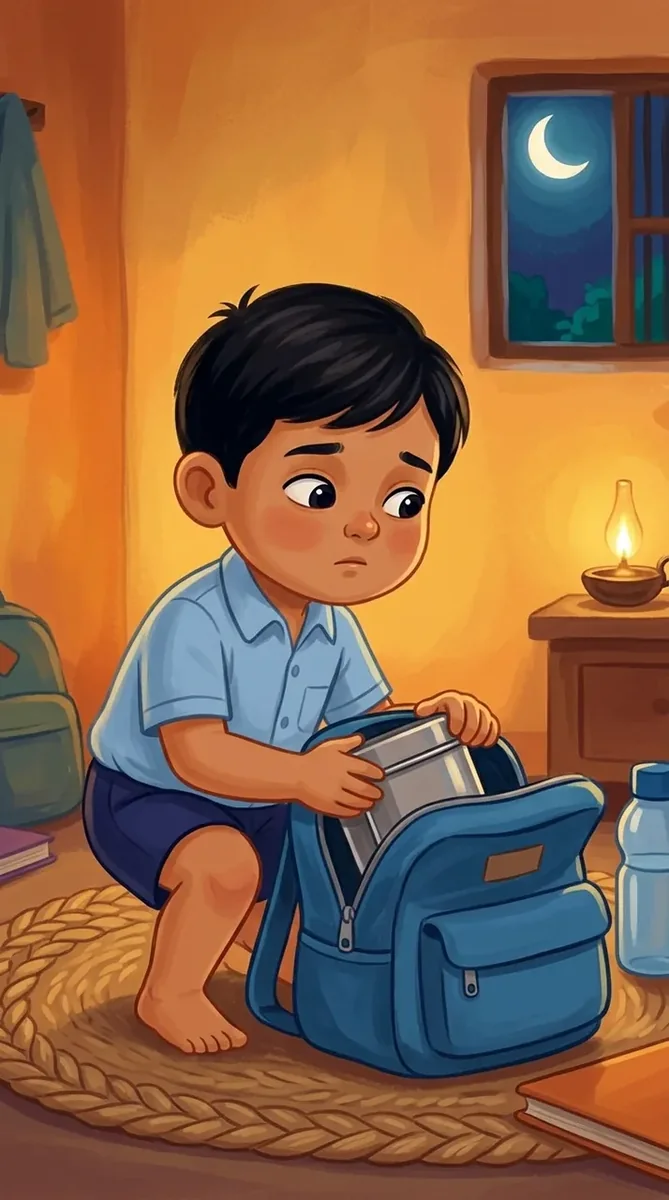
One morning the kitchen is quiet: the stove is lit but there is no pot on it. Maa says, very softly, that the flour and rice have run low this week; there is nothing for his tiffin today, though by evening it will be all right. Bittu takes her hand and says it does not matter, Maa. But one question circles in his head: when his friends ask what is in your tiffin, what will he say? He looks at the empty box a long moment — then packs it anyway. Nobody must know. His bag has never felt so light, or his heart so heavy.
Naani saysबस्ता आज कुछ ज़्यादा ही हल्का था… पर बित्तू का मन उतना ही भारी।His school bag was lighter than usual today… but Bittu's heart was just as heavy.
The story in pictures
Frames from Naani’s telling, in story order — the pictures your child sees while she speaks.

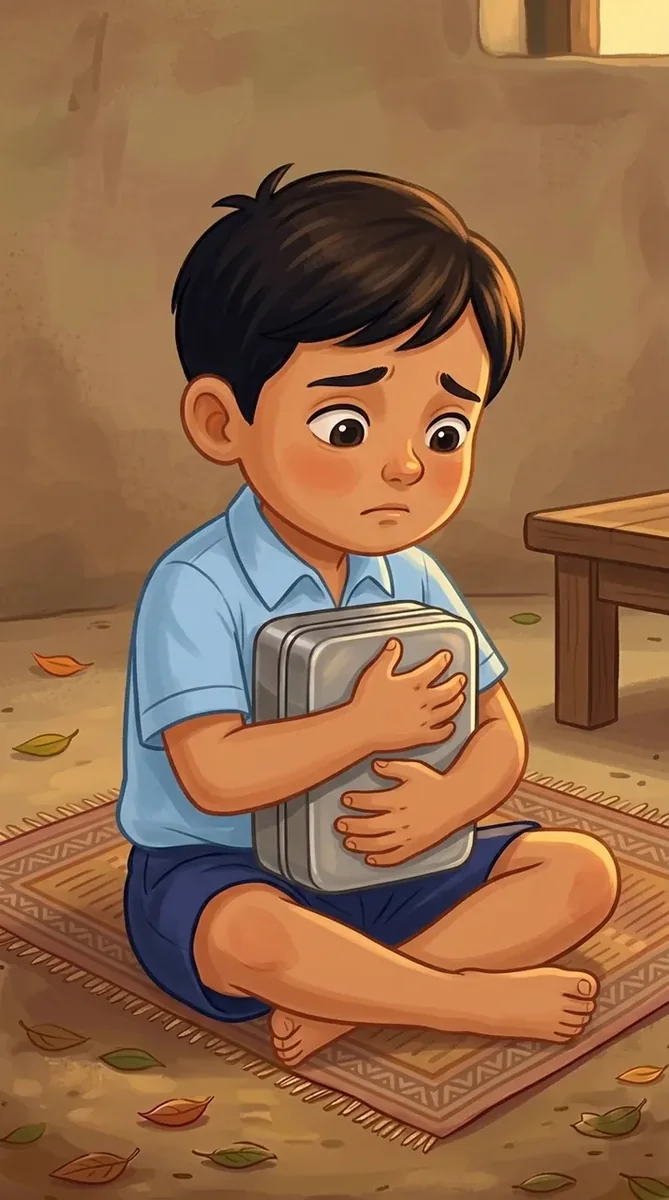


Under the neem tree the lids come off and the smell of aloo paratha drifts about. Bittu hugs his box in his lap, murmurs that he is not hungry, and slips away. Mira — his oldest friend, two plaits, sharp eyes — is watching. He has not opened his tiffin, and his face is drawn. Her eyes widen as she works it out: Bittu's box is empty. She asks him nothing and tells nobody. Naani pauses here and asks your child what they think Mira will do, and listens before she goes on.
Naani saysमीरा समझ गई — बित्तू का टिफ़िन आज खाली है!Mira understood — Bittu's tiffin is empty today.
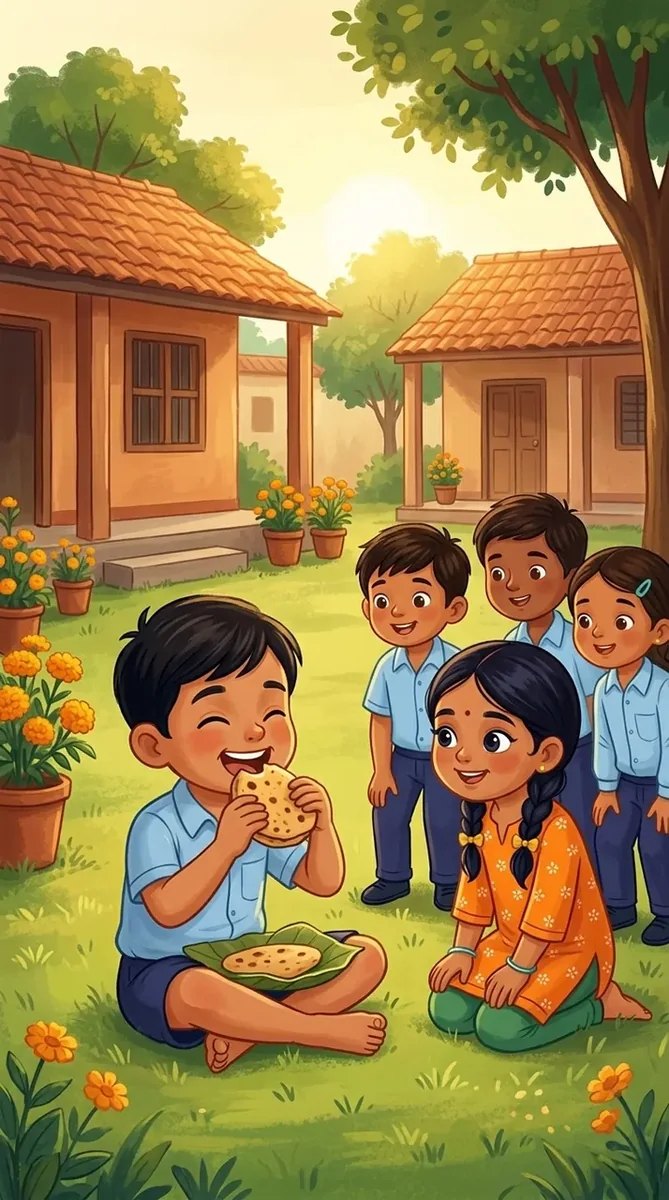
Mira stands up. Everyone — today we are playing picnic-picnic: all the food goes in the middle and we share. A cloth is spread, and parathas, poha and sweet rotis pile onto it. Then she calls: Bittu, hurry, there is no picnic without you — you make the leaf plates. Bittu lays a big leaf before each friend, and as the food goes round nobody notices whose box was full and whose was not. Paratha, poha and Mira's gur ki roti land on his leaf. He takes the first bite and his eyes fill while his mouth smiles.
Naani saysमीरा उठ खड़ी हुई और बोली, सुनो सब — आज हम पिकनिक-पिकनिक खेलेंगे।Mira stood up and said: listen, everyone — today we are playing picnic-picnic.
He floats home and tells Maa everything — the picnic, the leaves, Mira. Her eyes fill too, and she hugs him. Then Bittu asks: the guavas on our tree are ripe, aren't they? Tomorrow I will take them for everyone. That evening the stove is lit again, and Bittu falls asleep on his charpai counting stars, a small smile still on his face.
The value this story teaches
Sharing is the first value most parents teach, and the one most children resist. At four to seven it is usually enforced — 'give your sister a turn' — rather than chosen. What changes a child is seeing that sharing can be a game, and that it can make someone feel included rather than pitied.
Mira never asks Bittu why his tiffin stays shut. She invents picnic-picnic, spreads a cloth, and gives him the job of making leaf plates so he belongs before a single paratha is passed. When his leaf fills up, nobody knows whose box was empty. His eyes fill while his mouth smiles — and the next day he brings guavas.
How to talk about it at bedtime
- Ask your child: why didn't Mira just give Bittu her paratha straight away?
- Try: let your child choose one thing to put in their tiffin tomorrow specifically to share, and ask at bedtime who got it.
- Ask your child: has a friend ever noticed you were sad without you saying so? What did they do?
When to pick this story
- When sharing at home has become a battle
- If your child has mentioned a classmate who 'never has lunch' or sits alone
- The night before a school picnic or a shared lunch
Try asking your child
After the story, or the next morning on the way to school:
- Why did Bittu take an empty tiffin to school instead of telling his friends the truth?
- Mira never asked Bittu a single question. What game did she invent, and why was it kind?
- What is one thing from your own tiffin you would share with a friend tomorrow?
Meet the characters
A round-cheeked six-year-old who takes an empty tiffin to school so nobody will know
His oldest friend, two plaits and sharp eyes, who helps without asking a single question
Bittu's mother, who tells him softly that the flour has run short this week
From the app-store reviews
Two of the public reviews parents have left on Google Play and the App Store, quoted exactly as they wrote them.
“an intellectual way to describe the old stories for kids .”
Nice“Really cute idea for bedtime! I love how Naani actually listens when kids interrupt and responds as part of the story. The mix of Hindi and English feels really natural, and the gentle lessons are a nice touch. Such a lovely way to wind down before sleep!”
Give your child a story with a value every night
Naani tells Khaali Tiffin Box in warm Hindi, shows the pictures, asks a question halfway and listens to your child's answer. One story, one seekh, then good night.
Listen tonight — free- Free stories every night
- No ads
- Your child’s voice erased after 24 hours
- Made in India
About this story
- Language: Hindi — simple, in a grandmother’s voice
- Ages: 4–7
- Listen time: about 11 minutes
- Value: Sharing, Kindness & empathy, Friendship
- World: Naani's Lessons
- Theme: Help others while protecting their dignity.
Also plays in the browser: app.naani.live/stream/the-empty-tiffin-box (sign-in required).
Parents also ask
What is the Khaali Tiffin Box story about?
A boy whose family cannot fill his lunchbox one day, and a friend who notices and quietly turns lunch into a shared 'picnic' so that he eats without anyone knowing. It is an original Naani ki Seekh story about sharing, and about helping people in a way that lets them keep their dignity.
Does the story talk about poverty in a way that might upset my child?
It is handled lightly: Maa says the flour and rice are a little short this week and will be back by evening, and they are. The focus stays on Bittu's worry about being found out and on Mira's clever kindness. Most children fix on the picnic game and the guavas, not on the shortage.
What age is this story best for?
Children of five to seven who already eat lunch at school get it instantly, because aadhi chhutti is their world. Younger children enjoy the food and the picnic game. Naani's mid-story questions — what will Mira do now? — are easy for a four-year-old to answer out loud.
Next story
Do Nanhe Beej
A moral story about courage — being scared and growing anyway, one small push at a time.
More Naani's Lessons
All Naani's Lessons → Wisdom
Pyaasa Kauwa
A moral story about persistence and clever thinking — small efforts, one pebble at a time, solve a big problem.
 Wisdom
Topiwala aur Natkhat Bandar
A moral story about thinking before reacting — the answer is often right in front of you, if you stop and look.
 Honesty
Imaandaar Lakarhara
A moral story that teaches honesty without a lecture — a poor man says no to gold because it is not his.
More stories that teach sharing
The art of sharing — the thing that grows when you give it away.
 Sharing
Navratri Night 5 — Maa Skandamata
The fifth Devi of Navratri, told so your child learns that love shared is love doubled — making room on Mummy's lap never means less love.
 Sharing
Eid ki Pyari Eidi
An Eid story that shows your child what sharing really costs — and why it still feels like the sweetest thing.