Vaisakhi: Panj Pyare aur Khalsa ka Janm — the Vaisakhi story for kids, in Hindi
The Vaisakhi story, told so your child learns that courage means being the first to stand up and help.
वैसाखी की कहानी — पंज प्यारे और खालसा का जन्म
Hear Naani tell it
The story
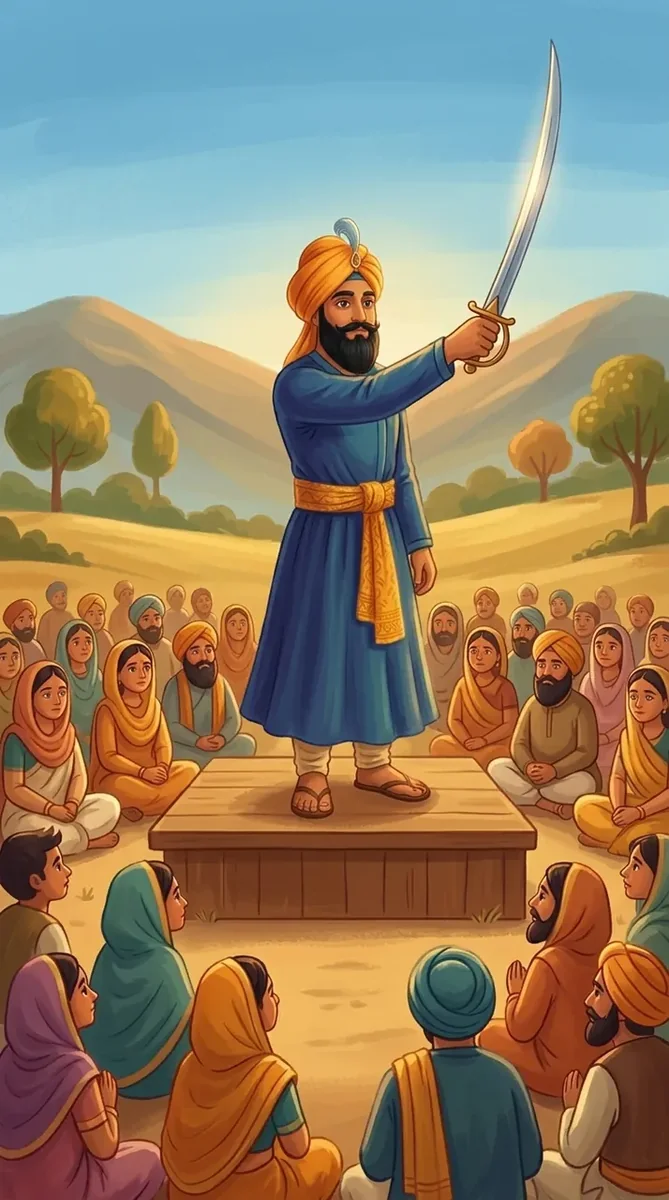
What this Vaisakhi story gives your child is a definition of courage they can use on Monday morning: being the first to stand up, before you know what follows. It opens on a field full of thousands of people, a bright blue sky, and one question so big that the whole crowd falls silent — and it is about who stood up first, and what happened in a small tent that changed Punjab for ever.
Naani saysक्या यहाँ कोई ऐसा बहादुर है, जो सच के लिए अपना सब कुछ दे सकता है?Is there anyone here brave enough to give everything for the truth?
It is Vaisakhi day at Anandpur Sahib, hills all around, golden sunlight everywhere, people gathered from far away as if for a great mela. In the middle stands Guru Gobind Singh ji, his voice deep and sweet like a great bell. Naani asks your child to picture the field and the sky. Then the Guru draws his sword and asks: is there anyone here brave enough to give everything for the truth?
Naani saysउनका नाम था दया राम। उनके चेहरे पर एक प्यारी सी शांति थी।His name was Daya Ram. There was a lovely calm on his face.
The story in pictures
Frames from Naani’s telling, in story order — the pictures your child sees while she speaks.
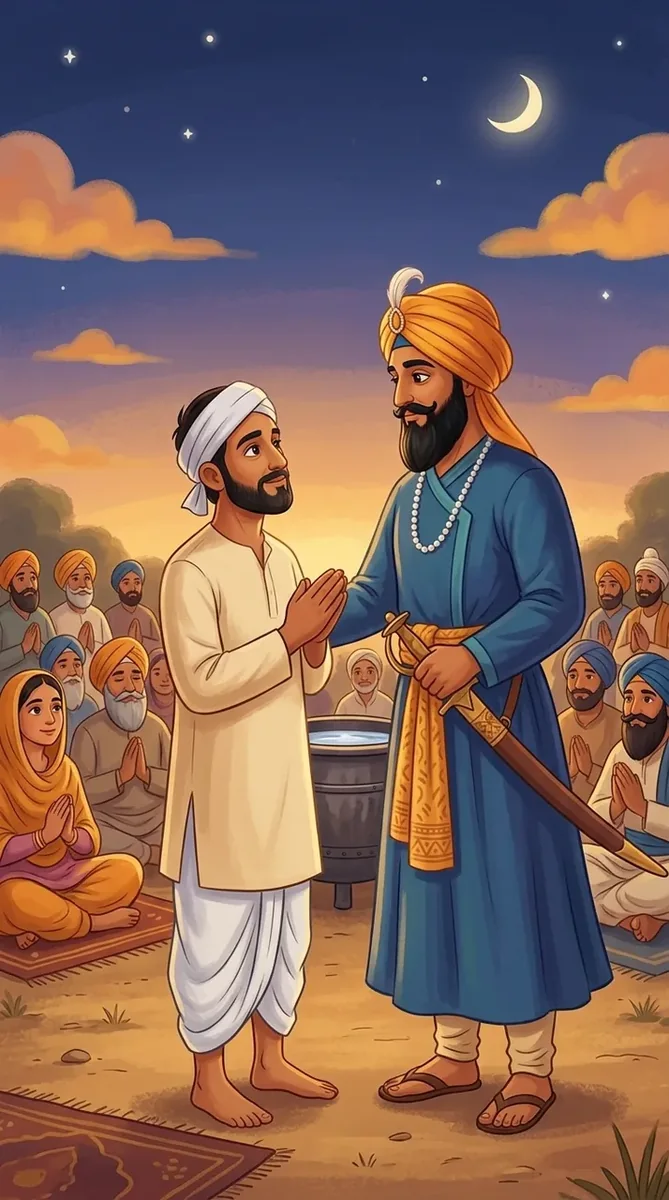
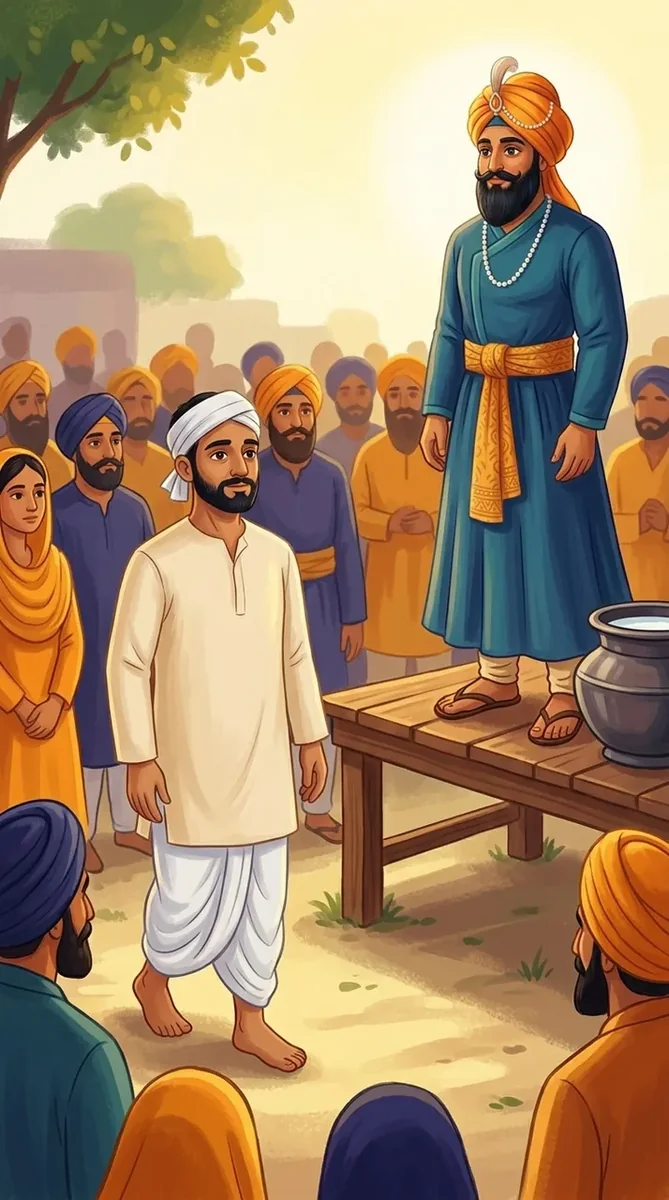

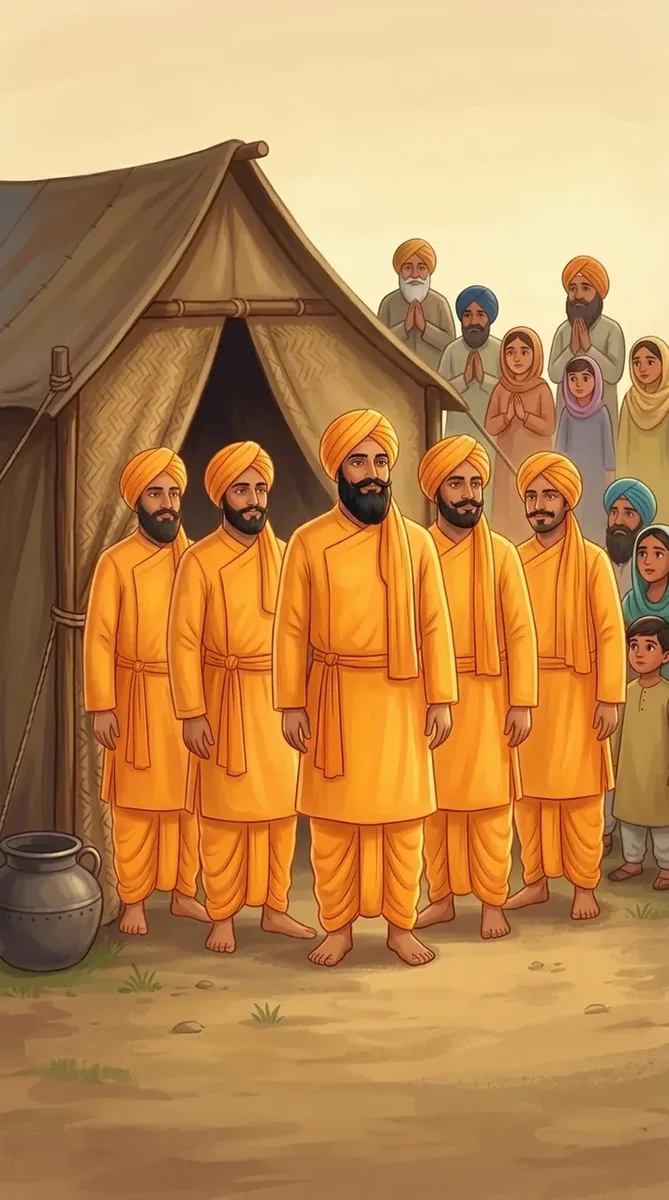

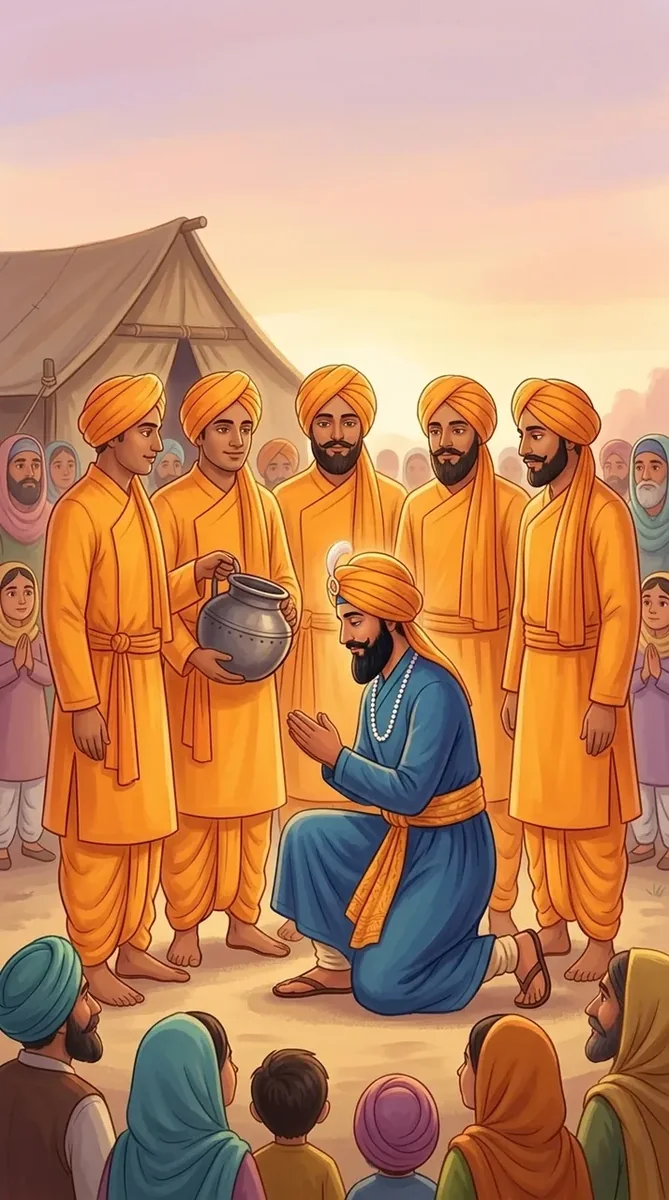
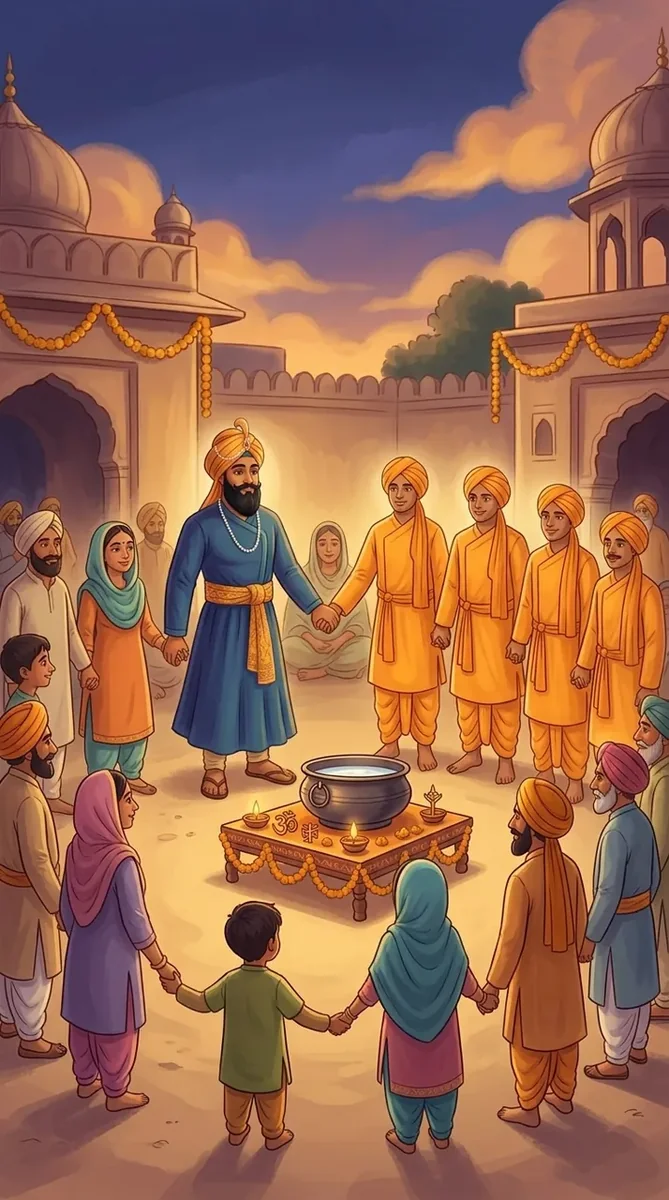
Silence — so complete you could hear your own breath. People look at each other. Then one man rises from the crowd: Daya Ram, with a lovely calm on his face. He walks slowly to the Guru and says, I am ready. This is where Naani stops and asks your child: if you had been sitting in that big, quiet crowd, would you have stayed as still and silent too? — and listens. The Guru asks again, and one by one four more stand: Dharam Das, Himmat Rai, Mohkam Chand and Sahib Chand. He takes the five into a small tent. The crowd waits. When they come out, everyone's eyes go wide — the five are dressed in beautiful saffron, their faces shining like the sun.
Naani saysवो पाँचों लोग अब सुंदर केसरी रंग के कपड़ों में थे और उनके चेहरे सूरज की तरह चमक रहे थे।The five of them were now in beautiful saffron clothes, and their faces shone like the sun.
The Guru names them the Panj Pyare, the five beloved ones. In a big iron bowl he takes water, adds a little sugar, stirs it slowly with his sword and calls it amrit. He gives it to the five and tells them: from today you are one new family — the Khalsa. Here nobody is big and nobody is small. We are all equal.
Naani saysयहाँ कोई बड़ा नहीं है, कोई छोटा नहीं है। हम सब एक बराबर हैं।Here nobody is big and nobody is small. We are all equal.
And then the Guru does what no one expected. He bows before the Panj Pyare, folds his hands and says: as I gave you amrit, now you give it to me. Naani lets that sit a moment — such a great Guru, bowing before his own students — and tells your child that a true leader is the one who treats everyone as his equal. From that day everyone became one, like beads on a single mala, and joy ran through the crowd. That is why we celebrate Vaisakhi every year. She ends by asking your child to feel a warm hug, as if they belong to one very large and loving family.
The value this story teaches
Children of five and six already know the moment this story turns on: the teacher asks a question, the room goes silent, and nobody wants to be first. Courage at this age is the willingness to stand up before anyone else does.
Naani makes that silence last — so quiet you can hear your own breathing — and then one man, Daya Ram, rises with a calm face and says, main taiyaar hoon. Four more follow only because he went first. Your child feels how one person's step gives everyone else light, and then watches the Guru himself bow to the five, so bravery and humility arrive together.
How to talk about it at bedtime
- Ask your child: if the Guru asked "who is brave?" in your class, would you stand up first? What would make it easier?
- Try: when your child owns up to something or helps before being asked, name it — "that was Daya Ram courage".
- Ask: why did such a great Guru bow to his own students?
When to pick this story
- Vaisakhi week, before the nagar kirtan
- When your child is nervous about putting their hand up
- When your child asks what the Khalsa is
Try asking your child
After the story, or the next morning on the way to school:
- When the Guru asked his big question, what did the crowd do — and what did Daya Ram do?
- Why do you think Guru Gobind Singh ji bowed to the Panj Pyare and asked them for amrit?
- Being brave means being first to help. When could you be first tomorrow — at home or in class?
Meet the characters
The tenth Sikh Guru, who asks the great question at Anandpur Sahib and then bows to his own students
The first man to rise from the silent crowd and say, I am ready
The five beloved ones — Daya Ram, Dharam Das, Himmat Rai, Mohkam Chand and Sahib Chand — who become the first Khalsa
From the app-store reviews
Two of the public reviews parents have left on Google Play and the App Store, quoted exactly as they wrote them.
“Great stories and really interactive. My kid love it”
“an intellectual way to describe the old stories for kids .”
Give your child a story with a value every night
Naani tells Vaisakhi: Panj Pyare Aur Khalsa Ka Janm in warm Hindi, shows the pictures, asks a question halfway and listens to your child's answer. One story, one seekh, then good night.
Listen tonight — free- Free stories every night
- No ads
- Your child’s voice erased after 24 hours
- Made in India
About this story
- Language: Hindi — simple, in a grandmother’s voice
- Ages: 4–7
- Listen time: about 7 minutes
- Value: Courage, Humility, Doing the right thing
- World: Festival Stories
- Theme: Courage is standing up first, before you know what follows.
Also plays in the browser: app.naani.live/stream/vaisakhi-panj-pyare-aur-khalsa-ka-janm (sign-in required).
Parents also ask
What happened on Vaisakhi in 1699?
At Anandpur Sahib, Guru Gobind Singh ji asked who would give everything for truth and faith. Five men — Daya Ram, Dharam Das, Himmat Rai, Mohkam Chand and Sahib Chand — came forward. He gave them amrit, named them the Panj Pyare, founded the Khalsa, and then took amrit from them himself. Sikhs mark the day as the birth of the Khalsa.
Is the sword or the tent frightening in this version?
No. Naani tells it the way a small child can hold it: the Guru draws his sword and asks a question, the five go into a tent, and they come out in shining saffron. Nothing is shown happening inside the tent. The mood is silence, wonder and then a wave of joy, and it ends with a warm family hug.
When is Vaisakhi, and what else does it mark?
Vaisakhi falls on 13 or 14 April each year, the first day of the month of Vaisakh. Besides the birth of the Khalsa in 1699, it is the spring harvest festival of Punjab — the wheat is ready — celebrated with nagar kirtan processions, langar, bhangra and giddha.
Next story
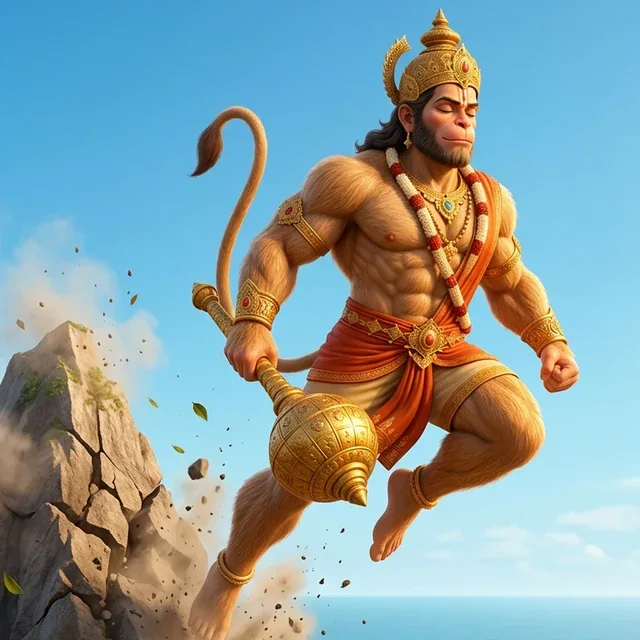
Naani Ki Ramayan 12: Hanuman Ki Samudra Paar Chhalaang
Hanuman's great leap across the sea, told so your child learns that we sometimes forget our own strength, and a friend who believes in us can remind us.
More Festival Stories
All Festival Stories →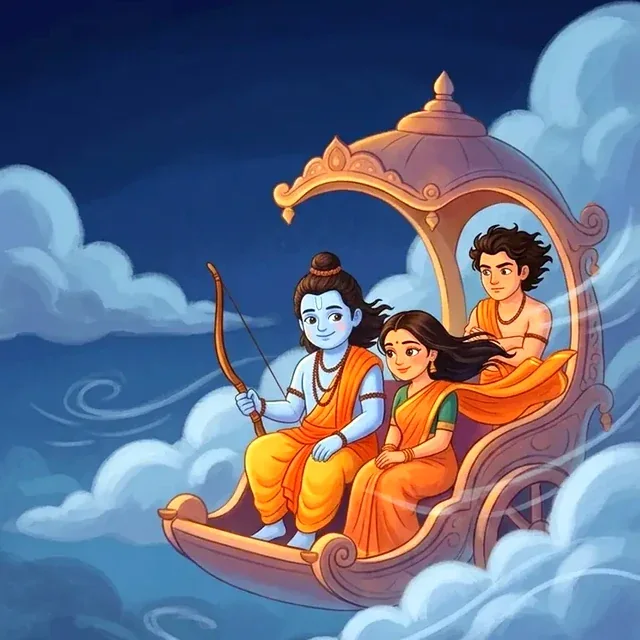 Faith
Diwali: Jab Ayodhya Jagmagayi
The Diwali story told so your child takes away hope, togetherness, and a prince who did his duty with a smile.
 Humility
Dussehra: Rama Aur Ravana Ka Antim Yudh
The Dussehra story, told so a five-year-old learns that ghamand loses and a calm, kind heart wins.
 Anger
Navratri Night 1 — Maa Shailputri
The first Devi of Navratri, told so your child learns that the strongest hands can still be gentle.
More stories that teach courage
Being scared and taking the first small step anyway.
 Courage
Govardhan Parvat aur Krishna
A Krishna story about a small boy using his strength for everyone — and a village that stands together.
 Courage
Krishna Janam aur Yamuna
A Krishna story about a frightened father who keeps walking — one step at a time.
 Courage
Chintu aur Magarmachh
A Panchatantra story that shows your child what to do with fear: breathe once, then think.